***
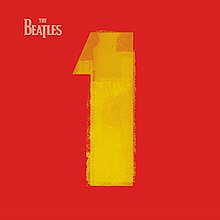 The Beatles: 1 (Apple 1962-70/2000) [r]
Almost twenty years later it seems so quaint: a greatest-hits collection heavily advertised on TV briefly became a pop culture phenomenon, selling 31 million CDs and revising the Beatles' original spirit as a youth culture touchstone (rather than as mere artists) for what will probably remain the last time, though they did manage to get back in our faces a few years ago when the catalog went streaming. It started a trend, too -- also probably the last time the Beatles will pull that off -- with Elvis, Beach Boys, Stones, even Wings following suit. As a fan, it was fun at the time to see the malleability of the Beatles' music confirmed, and it's especially comforting that George Harrison lived to see it happen. But at the center of this grandiose gesture, this is just familiar music in a fancy new dress -- an attractively minimalist package with decent liner notes, nice reproductions of the old Avedon photos and lots of Helvetica. As for the songs, obviously taken without any context they're almost uniformly phenomenal: "From Me to You," "All You Need Is Love," "Hello Goodbye," and "The Long and Winding Road" are the only bummers for me, and if you're a sane fan of pop music you won't have more than a handful either. However, two things give me pause: one is the impossibility of summing up the Beatles in a best-of. There's a reason the previous best attempt spanned four discs. (One earlier stab at summing things up more concisely, 20 Greatest Hits, felt facile and incomplete; if one just wants to define Beatlemania with the quickness, the old British EP The Beatles' Million Sellers gets it across more charmingly.) Virtually every Beatles album is essential for even a casual rock & roll listener, and so this can only serve as a convenient playlist for reliving their radio impact. Conversely, there is the fact that many of these songs weren't originally on albums, which brings me to my second point: defining the Beatles' legacy as a singles band while limiting the scope to the songs that topped the charts gives an impression that's often woefully incomplete. The most glaring examples are the absence of "Please Please Me" (which was a #1 in England, just not on the chart that later became canonical) and "Strawberry Fields Forever," without either of which any Beatles chronicle feels terribly lacking. Not to mention the oft-ignored fact that, since everything here apart from the first three tracks is in stereo, these aren't even the hit versions of these songs. If you think that's irrelevant, check out our Mono Masters review.
Apple's criteria for this release meant that any song that "officially" made #1 in either the UK or the U.S. was to be included, neatly coinciding with the ideal running time of a single compact disc. But this also lets in songs that the Beatles never intended as singles but were marketed that way in America, namely "Eight Days a Week," "Yesterday" and "The Long and Winding Road"; admittedly, "Yesterday" probably belongs on any greatest-hits package since it was massively popular and remains likely the most-covered song of the rock era. (My favorite version is Tammy Wynette's; Ray Charles' is good too. I love the song but never thought the Beatles' version lived up to its promise.) It continues to annoy me that, after more than a half-century, no one's ever just put all of the Beatles' 26 official A-sides in one place, in mono, and released them together; the playlist I've made in this format is revelatory in terms of narrative, and doesn't distract with sidelines and gray-area selections like 1 does. You get part of that same remarkable story of a band's development, peak and decline on this disc, but the portions that are missing really hurt -- like watching your favorite film edited for time. Of course, I understand 1 was meant for new and casual fans and thus stereo mixes and only the truly infallible cuts makes some marketing sense, but how much has the spirit of the '60s totally dried up when marketing is our primary concern here? Anyway, streaming renders a lot of this moot, but if you're still in the physical music market, skip this and just get the albums and Past Masters; this isn't exactly a case in which people crow about the album cuts being lackluster compared with the hits.
 The Beatles: Tomorrow Never Knows (Apple 1964-70/2012) [c]
The Beatles themselves rebuked EMI's procession of "themed" compilations in the late '70s and early '80s, those with names like Rock 'n' Roll Music, Love Songs, Reel Music and Ballads; understandably, they considered it all rather cheap. But a number of decades later, in celebration of the band's new presence on the Apple iTunes store (their long dispute with the computer company over the Apple trademark finally settled), they essentially approved the same idea themselves with this fourteen-track collection of some of their "harder rocking" songs. Existing only as an iTunes playlist and -- briefly -- a promotionally pressed vinyl LP, it's a totally useless creation meant apparently to keep the Beatles' name lively and valid to "new" fans and to suggest a legacy as edgy rockers that isn't accurate or necessary. Fans needn't bother with it, they have all of it except possibly the versions of "I've Got a Feeling" (from Let It Be... Naked) and "The End" (from Anthology 3); in both cases you're better off just springing for those full releases. So why does this exist? Quotes from Dave Grohl, members of several other mainstream bands, and a couple of token indie rockers accompanying the release are apparently intended to serve the same purpose as the testimonials from the likes of Fred Durst at the time of Let It Be... Naked, but does anyone who'd actually buy this feel impressed by such people? Grohl, after all, is himself at this point a "classic rocker," and one doubts that the Beatles are in any particular need to kowtow to "rockers" -- kind of a niche culture now anyway, right? -- to attract a wider crowd. It is just a silly iTunes thing, after all, but just glancing at it ("file under ROCK," the cover proclaims) you can see it was the result of far too many closed-door meetings about demographics and such. It just seems like a weird gesture from a band whose quality control tends to be so strict, but shortly after this, the reins would be loosened in a positive manner.
 The Beatles: Live at the Hollywood Bowl (Apple 1964-65/2016) [r]
At last, the Beatles' lone truly official live album came back into print in conjunction with the Ron Howard documentary about their touring years in 2016; Giles Martin remixed Capitol's three-track recordings to present the music and particularly the vocals with greater clarity. As a result, everyone from CD-buying grannies to neo-nostalgic Spotify teens can hear the shrill sounds of Beatlemania preserved in perpetuity, with the band brilliantly attacking "Things We Said Today," "She's a Woman" and others with relentless speed despite every kind of towering obstacle they confront. Rock & roll and forever-young sexuality live, baby. Apart from the horrible cover art, this supersedes the old LP release quite handily (I do not know whether George Martin's charming liner notes -- in which he recalls his daughter asking him if the Beatles are as good as the Bay City Rollers -- are preserved in the new physical issues) but it still feels a little like a missed opportunity. Rather than comprehensively releasing these three professionally recorded gigs, Giles Martin somewhat obsessively sticks to his dad's volleying back and forth between '64 and '65; I'm all for historical accuracy, but to a live album released with the usual caveats of LP length in 1977? Not so much. Instead he fills out the time with four bonus tracks, two from each year, collecting one errant track from the 1996 "Real Love" single ("Baby's in Black") while cutting out part of John's hilariously snippy intro (alleging that the song is "a waltz, for those of you over ten") for some reason; Lennon's above-it-all ranting is part of the Beatles live experience, goddammit. The others -- "You Can't Do That," fine; "I Want to Hold Your Hand" and "Everybody's Trying to Be My Baby," both a bit weak -- seem randomly selected, since we know the shows held other unusual gems like "If I Fell." Martin's justification is probably that the disc was meant, like the original LP, for a general audience of non-obsessives, but I can't see that putting at least two complete shows here would've really turned anyone off. It's not like they were lengthy. Repetitive, yeah, maybe, but imagine how the Beatles felt!

No comments:
Post a Comment