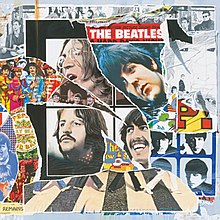
(Apple 1996)
HIGHLY RECOMMENDED
The first good news: no new song. That helps a bit, but there's more. This third installment in the series of supposedly bootleg-foiling unissued and obscure Beatles music functions as an actual album, one that forgoes the documentary-like obligations of the last two collections in favor of a subtle storytelling drive. Opening with a George Martin orchestral tidbit called "A Beginning," closing with a mix of "The End" that leaves the faders up and ends with the lost closing chord Anthology 2 left off "A Day in the Life," and dispensing with strict chronology in between, it's conceptually sound, historically engrossing and aurally pleasurable. Plus, almost everything here works on its own terms, because in contrast to Anthology 2, this is a collection dominated by an exceptionally good band actually playing together, experimenting and toying with songs that in some cases were already among their best, in others are herein revealed to be better than we ever thought.
The discs are divided, with atypical neatness, between sessions for the White Album and Get Back slash Let It Be; Abbey Road is represented, with a few exceptions, by the presence of its eventual highlights in demos and runthroughs from either of those two earlier periods. To start things off, there's an astounding series of demos for songs that would later surface on the White Album and Abbey Road; it would be a stretch to say they top the familiar versions, but they add something human to each of them. McCartney's "Junk," later one of the few worthwhile compositions on his solo debut, is better than ever here, warts and all. (The entire demo tape, once probably the best Beatles bootleg of all, was officially released in 2018.)
The remainder of disc one consists of delightful White Album sessions, some of them -- such as "Ob-La-Di, Ob-La-Da" -- surprisingly elaborate and far from their master recordings. The long, slow "Helter Skelter" reveals a buried, sensual groove in that song and offers some of the Beatles' most intensely focused playing, showing their credibility as a hard rock outfit maybe even more convincingly than the master take. A rehearsal of "Good Night" reveals it to be sincere and pretty instead of ironic and unsettling. An excellent, quiet demo of George's "While My Guitar Gently Weeps" makes one wish he'd never met Eric Clapton; his fully mixed outtake "Not Guilty" is also upsetting because it's so much better than his own version recorded a decade later. John Lennon is the big surprise in his enthusiasm both for the record as a whole -- his conversation with Paul after the runthrough of "Julia" is chilling -- and for studio experimentation. He presides over an early mix of "Glass Onion" and the fascinating, nightmarish "What's the New Mary Jane" (weirder and funnier than even "I Am the Walrus" and one of the best unreleased Beatles songs) like a gleefully mad B-movie producer. Yoko Ono's influence is clear, sure (he even sings her name on the "Happiness Is a Warm Gun" demo like a man possessed), but he's having genuine fun with this stuff, which of course would climax on the fabulous "Revolution 9." McCartney, too, is in contrast to his public persona quite laid back on these cuts, leading the band into a riveting jam of his given-away "Step Inside Love" that forecasts the looser moments of the Get Back sessions.
Not everything is significant, of course, though harder core fans will appreciate the small differences. The presence of "Don't Pass Me By" and "Octopus's Garden" is probably a token gesture. "Cry Baby Cry," "Blackbird," "Sexy Sadie," "Mother Nature's Son," "I'm So Tired" and "I Will" are not better or worse than their canonical counterparts in obvious ways, though all are good and fun to hear. "Rocky Raccoon" and "Hey Jude" are presented in rough versions that are more amusing than revealing, coming across very much as fly-on-the-wall moments of the band goofing off. "Why Don't We Do It in the Road?" is heard with a much more eclectic vocal from Paul, but was anyone exactly clamoring for an outtake of that one?
Anyone who's seen the film Let It Be or has slogged through the Thirty Days bootleg knows how boring a lot of the Get Back material is, but it's been selected with admirable restraint here and they come up with a lot of good material; topping Glyn Johns' near-canon acetate assembly and the 2003 release Let It Be Naked, Anthology 3 gives us the most respectful treatment of Get Back ever and makes the strongest case that it could have been as good as a "normal" Beatles album. Given room to breathe, "She Came in Through the Bathroom Window" is a unique beast in Paul McCartney's songbook. Good as the Abbey Road classic was, this methodical rehearsal is somehow more intriguing; the lyrics remain as mindbending as any of John's faux-Lewis Carrol: "and so I quit the police department." Disc Two's holy grail is the overdub-free "The Long and Winding Road," revealing it to be a far better song that one could imagine given the popular Let It Be recording, and the harder-rocking rooftop version of "Get Back," while all but previously released via the Let It Be film and numerous documentaries, is a strong runner-up. As with the White Album sessions, there are several wonderful performances that aren't terribly different from the masters Phil Spector (and Glyn Johns) chose: "Dig a Pony," "Two of Us" and "Let It Be" above all. The "For You Blue" here is a mess compared to the released track, though charming in its way. Aside from that, the best recordings from January 1969 are the ones that were never issued by the band: a band jam of rock & roll classics is delicious, and kind of fools you into thinking there was infinite material of that caliber from the sessions. Even Paul's "Teddy Boy" is rendered less painful with John Lennon making fun of it the entire time.
As noted, Abbey Road is under-represented, oddly since it has a good number of intriguing supplemental material that circulates. We do get a sharp "Come Together" rendered unusable when John cracks himself up, a ponderous "Maxwell's Silver Hammer," and a vocal-only mix of "Because" that is, admittedly, stunning despite requiring basically no work on the part of the compilers! (It inspired Elliott Smith's cover version a few years hence.) We also get a tidbit of the very last Beatles session, which John Lennon didn't attend, prompting an amusing prologue from George before launching into his relatively lackluster "I Me Mine," wrapped up apparently to help fill out the tracklist of Get Back-Let It Be, though at 1:48 it was singularly unhelpful in this regard, prompting Phil Spector to repeat a verse and stretch it out. There's no compelling reason for this to be here except to just mark the occasion of the Beatles' last moments as a band, and their only real 1970 recording session. (Ringo did attend the string overdub session for "The Long and Winding Road" and witnessed some considerable belligerence from Phil Spector on the occasion.)
The best moment of Disc Two is on a lazily impassioned Saville Row performance of "Oh! Darling," when John announces that Yoko's divorce has gone through so they can marry, and the whole band -- contrary to everything ever written about them -- is thrilled for him. But the best song is... well, it's hard to pick because halfway through they start to come out of the woodwork. The last half of this disc is when the Anthology album series finally becomes consistently great. Unfortunately, it's also the very end, but oh well. This stuff is incredible, and doubly so for those who'll never have the patience to mine all of the A/B Road sets or other bootlegs: a mournful, gorgeous version of Buddy Holly's obscurity "Mailman, Bring Me No More Blues," a similarly riveting Gene Vincent-like revision of "Ain't She Sweet" from the Abbey Road era that's ten times better than the 1962 chestnut, George's solo demos of "All Things Must Pass" and "Something," by far the best versions of both songs ever released (his solo "Old Brown Shoe" is a different matter, eclipsed by the full Beatles performance), and Paul's belted-out demo of "Come and Get It," superior to Badfinger's hit.
Anthology 3 also presents a philosophical version of the Beatles' breakup, which can feel like a slight copout but is perhaps closer to the truth than most outsiders would admit; the portrait it draws is of the band's fragmentation less of a loss and tragedy and more a natural outgrowth of four twentysomethings who'd grown up together forging their own path, which can clearly be heard in Paul and George's solo demo recordings, and in John's increasing fixation on his projects and relationship with Yoko Ono. "All Things Must Pass" suddenly means more than its smarmy rebuke of a lover, "Let It Be" taken out of chronology finally has the identity fans of 1970 tried to give it -- they make arguments for the inevitability of all this, and celebrate the fact that four men gained independence and fulfillment in their own ways. It's obvious that the Beatles themselves, with the possible exception of Ringo Starr, saw 1970 as the end of the beginning, not as the end, and Anthology 3 probably makes this argument better than any book could.
If one views the entire Anthology series as a multimedia project, it adds up to more than its individual parts -- the documentary has flaws, as do the CDs and book, but taken together they represent a mostly unique occasion of the creators of and participants in a major cultural moment actually talking through it all for us, though obviously with all the whitewashing and necessary glossing thereby implied. In a similar sense, the Anthology album sequence probably plays better if you look at all six discs as a complete entity, though knowledgeable fans will roll their eyes at some of the obvious gaps, which only twenty plus years later are starting to be filled in by Apple on larger-scale sets. (As you can read on the reviews I've written for the Purple Chick bootlegs, I have my own feelings of bewilderment about certain things not being here, though many were planned for inclusion and vetoed by one band member or another, and that's only including stuff that has leaked out over the years; there's surely a lot more that we don't even know about that could've made these collections even more robust, especially in the midsection. Though I will confess I have very little interest in hearing the infamous "Carnival of Light.")
In every sense that individual portions of the discs can be criticized, though -- if you take out all the pointless and insubstantial remixes and redundant material, you could most likely pare it down to four excellent discs instead of six inconsistent ones -- the sheer quantity and commitment to illuminating the story for fans is impressive, and we've gone this far without ever mentioning the outstanding liner notes by Mark Lewisohn, which greatly enhance the listening experience and are keenly written, even when you sense the gritting of his teeth at having to pretend you're listening to anything special (see the dreadful "Lady Madonna" and insubstantial "The End" remixes). (If you only know these compilations from streaming services, I unequivocally recommend seeking out physical copies -- the booklets are easily worth whatever you're likely to pay for the entire package in the waning days of the CD era; these sets sold briskly and I'm sure used copies are everywhere.) Overall, as the Beatles were well aware, the story told on these three albums is infinitely compelling, taking the most gifted rock band of all from the cellars of Liverpool to the rooftops of London in a matter of hours.
[Expanded from a review first posted in 2003.]

No comments:
Post a Comment