Saturday, May 4, 2019

They live inside all that love: April 2019 music diary

Marvin Gaye's You're the Man is one of the lesser "great lost" albums to see release in the current century, but really only because nearly all of its music has already made its way out on various anthologies. It can be seen as a bridge of sorts between two of Gaye's most ubiquitous and long-lived masterpieces, but not a particularly revolutionary one. (That's despite the claims of note writer David Ritz, which isn't surprising, as Ritz strongly champions the unissued record in his biography of Gaye.) Also, a number of its tracks have been newly remixed, so it really qualifies as just a new and highly focused compilation. Gaye's discography will eventually be under the microscope here and at that point I will give the record the full treatment it deserves.

For many of us in our mid-thirties, it's still counterintuitive that times just... change. We remain the passengers in our bodies -- even as they start to let us down -- and we've experienced all of this life on a continuum, so it seems strange to actually start to witness firsthand the passage of What Was into What Is and Will Be. There's sometimes sadness in this development, and sometimes unheard-of possibility, as when a beloved singer-songwriter, currently in what by all logic should be the twilight of his relevance as a performer, turns the camera on the world around him and uncovers depth, beauty and truth, and a voice you've been hearing for almost two decades abruptly becomes a modern-day salve for distinctively modern-day blues. And that's when you say hello.

***

Andrew Bird: My Finest Work Yet (Virgin) [hr]
In which, somehow, a musician whose lyrics have typically been free-association propping up generalized pretty vibes -- and we loved him for it -- springs forth with some serious Thoughts on a dying planet, a struggling society and a climate of hate, and for whatever reason matches it up with his most creatively energized music in at least a decade. Not that he's ever been anything but a hard worker, but you can feel in every bit of carefully filled (and economically-minded) sonic space on this record that at age 45 he's hit upon a moment of genuine, unforced inspiration. The cheeky title is unpretentious because it's a joke, and also because deep down he knows it's true; it's appropriate because, like the content, it's an attack on apathy. But not a call to arms, which would be gauche and empty coming from this source; rather, a spirited questioning and taking of stock. But at any rate, let's talk music, which is gorgeous, confident and "big" out of the gate with "Sisyphus," declaring an aural mission with the heavily echoed pedestal he's willing to place himself on as he whistles and wraps around the first of many instantly ingratiating melodies on offer here. The confidence carries over to the much jazzier, lower-key chide "Bloodless," also perfectly suited to his voice both at the outset and when it builds to its almost McCartney-like sweeping chorus. Across the record but perhaps especially here, on a verbally and emotionally demanding song ("the best lack all conviction / and the worst keep sharpening their claws / they're peddling in their dark fictions / while what's left of us, well, we just hem and we haw"), Bird has never impressed so much as a singer; it never used to be the point, really. When I first heard "Lull" on the radio I thought he was Beck. Beck even at his best never achieved this direct, human collusion of the sly and the sincere, and he certainly never sang any word the way Bird sings "Catalonia."

The surprises continue, the record shockingly generous given its relative brevity: "Fallorun" is an urgent and gorgeous take on New Order's "Ceremony" about society systematically falling apart, the bitingly anti-GOP "Archipelago" beautifully interpolates the Four Tops, and perhaps best of all, the classic, pragmatic Bird-isms ("come on everybody, let's settle down") of "Don the Struggle," vaguely challenging the aged, tone-deaf and ideologically hopeless suddenly give way to a wonderful explosion of sing-song rapid fire excitement that scans so well you suspect it couldn't make half as much sense as it does: "Clinging to the thread of the notion that your fight is a righteous one / the more you have to try to convince yourself / the more you're gonna hear a dissonant sound / but dissonance is energy while the consonance reminds you of your poverty / do you follow me?"... which gives way seamlessly into a fiery j'accuse on complicity disguised as a love ballad, "Bellevue Bridge Club." The careful phrasing and devotion to a theme are nothing new for the singer-songwriter field, but at a stage in his career when he's long established, Bird seems to have unexpectedly turned a corner here, with everything from melodies to arrangements more developed than ever before; and while it's not as if he wasn't "good enough" before, it seems proper to cite and admire this as a surprise, a comforting gift and a challenge worth celebrating, even if it's these "troubled times" that have wrought it.
Ibibio Sound Machine: Doko Mien (Merge) [hr]
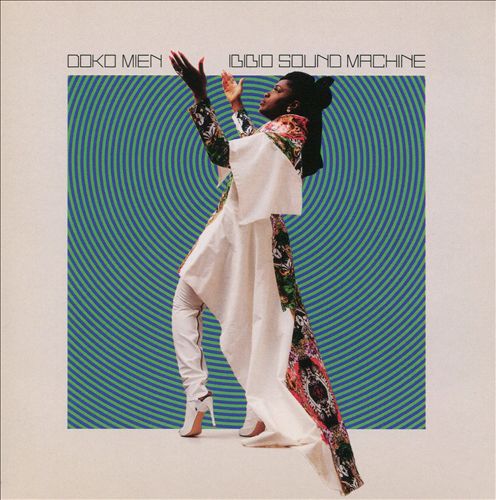
Not simply worldbeat, not simply disco, not simply post-punk, this miraculous third album from Nigeria-raised Eno Williams and her crew of ferocious funk magicians is the sort of music that makes you newly aware of the fact of being alive, and not just pleased but thrilled at the revelation, even if you're teetering just on the edge of life and sanity. "I Need You to Be Sweet Like Sugar" matches its top-of-lungs David Byrne-like rant with bristling sensuality, then the horns and itchy Bernie Worrell-isms show up in time for "Wanna Come Down," whose undeniable, grandiose discotheque trickery and incredibly persuasive rhythm taunt in unsion with Williams, back in her family's Ibibio language. For her part, Williams has never had such an opportunity to demonstrate her outrageous eclecticism, bouncing from pure silky soul to hopping chants to Yoko Ono-like cries on "Nyak Mien" to a wild transformation to a musical saw on the powerful, beat-driven title track. Ibibio isn't a throwback band -- everything about the music and performances is present and vital and so very right now; the only similarly lively music I can think of currently being produced today is in the realm of dance-driven electronica -- but this album is full of remarkable moments when you can hear the weight of history and the disappearance of time as a construct; the "what more can I do" hook on "Doko Mien" itself is a great example, and so is the "King's Lead Hat" riff on "Nyak Mien," and the entirety of the unbearably funky "I Know That You're Thinking About Me," on which Williams' command is both so undeniably singular and seems to shoot Grace Jones and Patti LaBelle and Bjork all together into the sky. The stomping "She Work Very Hard" achieves that same impeccable synthesis of classic popcraft and monstrous, indescribable groove. But the bread and butter of ISM remains their vicious rhythms and unpredictable vocals, and the entirety of this wonderful, joyous, dangerous album fulfills every kind of potential they've already displayed even on its slow-burn cuts (the sneaky, mysterious "Kuka" boasts lovely electric guitar and Williams' most sensitive, lilting vocal, and that's just the tip of the iceberg here). This is very much the sound of a grand outlet achieving their zenith; whether it continues past this or not, we're lucky this is recorded and here for us in our time rather than either a distant memory or an unknown, unheard tree falling in the woods.

American Football: LP3 (Polyvinyl) [r]
Real 1998 hours from an Illinois cult band that defined the morose underground emo sound of the pre-mainstream era of that genre; like their older work, this is obviously an acquired taste, but as a mood it's basically beyond critique: detail, intricacy and emotional melancholy baked into its ringing guitars and tentative melodies. It's the kind of record on which "plodding" is a compliment; these are grown adults with 401Ks now but you can't hear "Every Wave to Ever Rise" without reaching back to putting off homework in favor of chatting with girls on ICQ, then turning on the TV and getting depressed. Projecting, maybe. Hey, "Life Support" borrows a Radiohead riff!

Nilüfer Yanya: Miss Universe (ATO) [r]
Lush debut from British singer who's not trying to be someone makes heavy use of a variety of collaborators but enjoys a soothing consistency informed by the 23 year-old's admiration of radio pop dating from the time of her birth. In other words this is another lush neo-adult contemporary pop album with traces of trip hop and late-'80s pop balladry, and while not nearly as strong as Flock of Dimes' definitive If You See Me, Say Yes (or the all-time touchstone, Pet Shop Boys' Behavior), it provides a welcome injection of youth into this slightly revisionist genre and a fine showcase for Yanya's exquisite singing voice, capable of evoking Annie Lennox (listen to "Paradise," complete with sax) as often as more calm and collected inspirations like Tracey Thorn, whose Mike Leigh-like attraction to naturalism would never permit something as off-kilter as "Heat Rises." Of course it's all a bit square -- less square than Adele or Dido or Ed Sheeran, sure, but still essentially a potential symbol of future inspiration toying with adults' old ideas, like if the first wave punks had just done rockabilly covers -- and I don't think its particular injection of playfulness, a series of skits riffing on phone prompts, is entirely successful, and they make an overlong record bulkier yet. But the music is never less than very good -- the least distinctive songs are still catchy and well-sung -- and at best it's sumptuous and delightful, starting with the stern hooks and heavy guitars of "In Your Head," moving to the slickness and lilt of "Angels" and the unexpected hi-NRG bridge of "Baby Blu." Best of all is "Tears," a vintage groove with an exposive hook and just the slightest bit of bent-note strangeness; when she tries again, if we can expect more of this impatient fumbling toward the edges, it will be welcome.

Jenny Lewis: On the Line (Warner Bros.) [hr]
However much accused sociopath Ryan Adams may have informed the production of this record, the fact remains it sounds absolutely heavenly: vintage compression, the unmistakable crispness of analog tape and drum sounds that batter you so completely you'd swear you were listening to Jim Keltner and/or Ringo Starr. (Don Was plays bass too.) But it's thanks to Lewis herself and her modest but never-more-evident brilliance as a composer that this cycle of Brill Building country-ish pop goes beyond aesthetic pleasures and positively sings (as does she, belting the hell out of "Little White Dove" with seemingly no sonic limit, and channelling Susanna Hoffs' intimidating friendliness on the title cut). Lewis' absolute confidence as a singer provides for an embarrassment of riches in mood, offering untimitaged joy on "Rabbit Hole" but presenting herself as a florid, hard-living superstar on "Hollywood Lawn." It's all very throwback and sentimental, yearning (not unlike She & Him's records) for an AM radio past that those of us too young to have experienced can't help but romanticize, but it transcends the limitations of nostalgia (unlike She & Him's records) and certainly of "classic rock" as a concept, regardless of who plays on it, through the obvious and long-known toughness in Lewis' writing. "Red Bull & Hennessy" is propulsive and old-world, but its closing breakdown suggests a dismal horizon beyond; the piano-driven "Wasted Youth" is lovely, soulful and catchy with as much a power pop sunlight sound as any harking back to girl groups, but there is a new yearning in her words and voice. Even at its most inconsequential, the record at least charms, and its chief export is its mere exuberance, which at a moment like this can feel life-saving, like listening to the radio used to be.

Billie Eilish: When We All Fall Asleep, Where Do We Go? (Interscope) [r]
An L.A. teenager gets drunk on the possibilities of her idiosyncratic voice while her brother has the time of his life with the new Full-Dimensional stereophonic sound. It's a very pure sort of narrative, and the chord it's struck worldwide is something of a victory for a presumed generation of young weirdos. Once she removes her Invisalign, we're permitted to spend time with Eilish's strange and truly unusual, singular voice, the possibilities of which she spends the entire record exploring through songs she writes with sibling Finneas. The songs are often barely there, she's often barely breathing, and while the production suggests trap, it's really something odd, minimalist and genuinely risky. "Bad Guy" is one of the vaguest songs ever to become so popular (I don't like it when she says "duh" -- seems a copout -- but everyone else does), and the expressions of villainy and drugginess ("Xanny") that follow provide new dimensions in low-toned vocal seduction. Make no mistake: it's real singing, surrounded by flipped-out stoned blown-out production, and it's also truly and wholly Contemporary. It does bear the marks of adolescence a bit, but so did Fiona Apple's first album and Robyn's first several, and besides, "All the Good Girls Go to Hell" might have had the same Jungle Book cartoon playfulness about it if it came from a song factory, but it wouldn't have seemed so genuine and playful, and it certainly couldn't have been delivered with this degree of Prince-scale minimalism. It crashes a bit in the second half; the last better-than-average song is the ukulele-driven "8," when her voice gets treated into otherworldliness, but what follows continues with the engaging intoxication, the slight beats and the anti-relationship ballads buried under synthetic percussion. (Meanwhile, why an Office sample?) Free inspiration for the day: team these two up with SOPHIE and see what happens.

Weyes Blood: Titanic Rising (Sub Pop) [r]
Pleasantly bleak as usual, now with bonus assertiveness!

Fennesz: Agora (Touch) [r]
Now in his late fifties, the Austrian experimental artist returns with more solid, heavy atmospheres of guitar and electronics, maintaining a quiet roar. Exactly what you expect, which is just fine.

Lady Lamb: Even in the Tremor (Ba Da Bing) [r]
Aly Spaltro's in love and we should be happy for her as we should be for any quality human being who finds it, and you can hear the giddiness in her voice throughout this ambitious album (follow-up to one of the decade's best, After), but she's also no more infallible than many others when it's caused her to soften her blows a lot. Ridiculously intelligent as always, her unstoppable barrage of clever and sensitive lyrics and the attendant obsessions with unpredictable rhythms, time signatures and multi-part compositions in the overstuffed, cerebral vein of Scott Miller have suddenly found themselves rubbing up against a rather soppy, florid, almost Diane Warren-like pop sensibility, most audible on the overbaked chorus of the closing adult contemporary tearjerker "Emily," which isn't worthy of Spaltro's own narrative of "crying on the passenger side of America." The songs are less musical, busier, their pleasures more fleeting, and while the trickiness occasionally kills, the new tracks have a hard time ingratiating, though there are contexts in which it all seems perfectly wrought, when the monster chorus of "Deep Love" and its weird closing key change seems touching and adventurous rather than syrupy and careworn. The songs are best when they take pains to evoke just what they're talking about, which is one reason the verses of "Deep Love" resonate when she narrates fixing her lover's hair and chatting with a friendly couple next door ("passing by a pure scene in somebody else's life gives my life meaning," she says, and while it's Agnes Varda she mentions elsewhere on the record, I can't help thinking of Frank Borzage) and also one reason the title track is so convincing in its documenting of anxiety: because it doesn't just have the words ("it takes a conscious effort to hollow out this head / my brain is a constant rain on its own shelter"), it has the feeling. The most epic of the songs, "July Was Mundane," is one of the vaguest lyrically; and the strongest, "Oh My Violence," is the one that has the least trouble scanning its complicated verses into melody.

All that said, this is an artist I want badly to go to bat for -- I'm psyched to be seeing her live later this month -- and I don't think we can just dismiss this record because of words that are mismatched to songs when the words are this good, and in fact tremendous. "It's all that I want to do / to love you, to witness together how clumsy we are / how candied, how calcified, how mesmerized and how small / to share in the cosmic joke, to fall to a thousand floors and laugh / to soar, to take out and soar through the strange things we do." That would still be miraculous if you sang it to the tune of "De Do Do Do, De Da Da Da." And I can't hum "Strange Maneuvers" to you after trying to get to know it, but I'll never forget the central passage of its I-need-therapy rock & roll: "I don't wanna be afraid of myself anymore / after wading all day in my kiddie pool brain / my last stitch is a ticket to a matinee / but my attention span is too broke to play / I can't stop replaying my mistakes over and over / and over, and over, and over." And I'll never forget the childhood memory of religion and death on "Young Disciple," in which she concludes she once permitted herself to believe in an afterlife "as an impassioned follower of my beautiful mother," but it's barely anything resembling music. And maybe there's an argument to be made that it needn't be; but if so, Spaltro's previous work seems to contradict it.

The Chemical Brothers: No Geography (astralwerks)
Not a terrible workout tape. Not pretty either, which is the best they can do nowadays, and the samples around which they build these tracks are mostly insipid.

Loyle Carner: Not Waving, But Drowning (Virgin) [hr]
The hard-won confessionals and playful rhymes of Yesterday's Gone gave no suggestion to the troubled, depressive flow on this South London rapper's sophomore record; like Lady Lamb, he's in love, but it's fascinating how unrecognizably different a place it takes him. The rhymes are sharp and quick-witted, clearly taking stock of a long and complicated past, but the mesmerizing thing is how morose and cloudy the record is. Full of ease, yes, but also rife with an unresolved, unsettled feeling that makes it strangely irresistible. Boasting well-placed hooks sung by Jorja Smith and Sampha, the record achieves a lilting, poetic sense of journey across its fifty minutes, and it's quite shocking how much fear, stress and bleakness it manages to encompass given that it climaxes with his mum effectively giving him away (a bit of a repetition of the end of the first record, and not wholly needed here, nor are the samples of footie gatherings or Carner ordering chicken soup, but you know how rappers are). From the fiery Rebel Kleff hook at the center of "You Don't Know" to the equally compelling one he concots himself on "Still" on through to freestyling through "Sail Away" and some thorny contemplation of his racial heritage on "Looking Back," Carner positions himself modestly as one sound among many on a record with the same chilled-out vibe of a lot of classic Roots albums, only here with the oppressive yet all too calming sound of encroaching grief and paralysis. "Loose Ends" ("a lot of love a lot of loose ends / a lot of people that I wish I knew then") and "Ottolenghi" along with the unshakeable piano hook on "Carluccio" are the quintessential moments in which Carner's hip hop bona fides and the musical grace of this remarkable record sing out in an impeccably judged synthesis. Sometimes a record is the right piece of music for everyone's moment; sometimes a record is the right piece of music for you, right now, and this is that for me -- private, specific and empathetic in its treatment of a dark night of the soul, it's what I needed, coming from a source I did not at all expect.

Lizzo: Cuz I Love You (Atlantic)
Lizzo's transition from queen of the filthy Minneapolis indie rap scene to a amiable feel-good R&B singer signed to Atlantic remains weird if not disheartening, not that she isn't still a lot of fun to listen to, but you might as well get most of these songs prepped for their highest purpose as future Drag Race lipsync showdowns, especially the music-hall title track, which for all its charms is essentially a Mad Libs-like exercise in generic platitude-pop, as is the self-love anthem "Soulmate," which has nothing on various prior self-love anthems in her catalog. Most of the record is either dated or derivative -- "Jerome" is well-sung neo-doo wop clearly taking its inspiration from "Love on the Brain," which obviously throws it out the window; "Lingerie" is agreeably dramatic enough to be an Idol show-stopper but bears all the marks of artistic surrender; and "Better in Color" and "Crybaby" shoot for a funk-rock crossover market that no longer exists -- and coasts entirely on Lizzo's engaging star quality, which in fairness is far from nothing and certainly can put something like "Jerome" or the amusing "Heaven Help Me" ever so slightly over the line. The guest shots from Missy Elliott and Gucci Mane are promising and are at least identifiably hip hop but come off, respectively, as badly dated and awkward, the latter through no fault of Gucci's since he turns in a serviceable verse that's saddled with a dreadful hook courtesy Lizzo herself that sounds like a middle school football cheer. The album tries to do too many things and excels at none of them, with no many conflicting forces at the helm, but hey, it got her on the charts.

Angelique Kidjo: Celia (Verve) [r]
Winning and high-energy as always, Kidjo turns her attention to salsa with this tribute to Celia Cruz, the celebrated Cuban singer who Kidjo saw perform in Africa in the mid-1970s. As ever, Kidjo makes the music her own (with bass from Meshell Ndegeocello and several contributions from Sons of Kemet) and even if the transition isn't as mindbending and revelatory as what she did with Talking Heads last year, it's still an inexhaustible delight, particularly "Toro Mata" and "Bemba Colora," which stretch grooves out before ruthlessly puncturing them, always with Kidjo herself leading the onslaught.

Little Simz: Grey Area (Age 101) [hr]
Songs entitled "Pressure" and "Therapy" serve as earmarks for how this eventually turns into a self-confessional comedown, but for the first two thirds, this Islington rapper who spits, mocks and examines with equal speed and confidence is totally ablaze along with producer Inflo. It never again attains the synergy of the breathtaking opener "Offence," but the corrupt video game hook of "101 FM" comes close, and the hooks on "Boss" and "Selfish" demonstrate a commitment to popcraft you wouldn't necessarily expect from someone of Simz's raw, ruthless talent. No wonder, though, that the midstream highlight is "Venom" when she comes out swinging like the Count Five in 1965 with "Life sucks and I never tried suicide / mind's fucked even more than I realize" before revealing not only that she's out for blood but whose and how much. At its best, the hardest hip hop record in a while... but by design, so much more.

Robert Forster: Inferno (Tapete) [hr]
The solitary thoughts and textures of a Go-Between who never stopped loving rock & roll and never stopped looking directly into the present (and the ordinary), regardless of how thoughts lost and lives past may weigh in his mind; it means more than what we get from Peter Perrett or Richard Thompson, both of whom continue to write and perform more strongly than the majority of their aging peers, because in Forster's case the job seems so much more deliberate, but also totally unpretentious. He works slowly and only shows up to share with us when he has something to say, and these subtle, winding melodies and narratives give us plenty to unlock over what will surely be years -- "No Fame" and "Remain" cast his storytelling prowess and Velvet Underground fandom with boundless warmth and only the most mature, knowing kind of resignation, and "One Bird in the Sky" bows to charmingly pure pop, but it's the kind of record on which I'm quite sure my favorites will change each time I listen. He wouldn't bother us with all this if he didn't believe in every bit of it, and it's hard to think of another artist of his generation you can still say that about. This is probably Forster's best collection of songs since his old band's heyday, and for all its calm you can easily put it up against a younger band with similar aspirations like Rolling Blackouts C.F.; if this music is informed by the banality of getting older, may that experience stretch on into beautiful infinity.

ALSO RECOMMENDED
- Yola: Walk Through Fire (Nonesuch) [Civil Rights-era soul transported from Bristol to the Grand Ole Opry; "Love All Night (Work All Day)"/"Faraway Look"/"Shady Grove"]
- The Japanese House: Good at Falling (Dirty Hit) [Amber Bain comes on like Wye Oak turned left at Greenland; "We Talk All the Time"/"Worms"/"Follow My Girl"]
- Adia Victoria: Silences (ATL) [baroque country saddled up with cushy '90s alternative]
- Nick Waterhouse (Innovative Leisure) [as usual with these delightful retro types, we 100% got the sound but not the songs]
- Stella Donnelly: Beware of the Dogs (Secretly Canadian) [righteous indignation -- "my mum's still a punk and you're still shit"]
- Stephen Malkmus: Groove Denied (Matador) [at home with the groovebox (and sounding more like Lou Reed than ever); "Grown Nothing"]
- Feels: Post Earth (Wichita Recordings) [classic vintage brattiness eventually flatlines but wishes it could be like David Watts; "Awful Need"/"Deconstructed"/"Car"]

ALSO RECOMMENDED FOR THE AMBIENT FILES
- Teeth of the Sea: Wraith (Rocket Recordings) [a bang then a whimper then a whimper then a whimper then a bang then a whimper]
- The Comet Is Coming: Trust in the Lifeforce of the Deep Mystery (Impulse!) [gamely auditioning for a ridiculously limited audience of giant ears.. oh, and Kate Tempest shows up; "Birth of Creation"/"Blood of the Past"]

FURTHER INVESTIGATION TO COME
* Mary Lattimore & Mac McCaughan: New Rain Duets
* Ex Hex: It's real
* Quelle Chris: Guns
* W.H. Lung: Incidental Music
* BTS: Map of the Soul- Persona
* Elva: Winter Sun
Orville Peck: Pony
Avey Tare: Cows on Hourglass Pond
Jayda G: Significant Changes
Lee Fields & the Expressions: It Rains Love
Rozi Plain: What a Boost
Priests: The Seduction of Kansas
The Budos Band: V
Bibio: Ribbons
Shovels & Rope: By Blood
Anderson .Paak: Ventura
Stealing Sheep: Big Wows

REJECTS
Durand Jones & the Indications: American Love Call
The Claypool Lennon Delirium: South of Reality [NYIM]
Nakhane: You Will Not Die [NYIM]
Spelling: Mazy Fly [NYIM]
These New Puritans: Inside the Rose
Lucy Rose: No Words Left
La Dispute: Panorama
Shlohmo: The End
Devin Townsend: Empath
Steve Earle & the Dukes: Guy
Edwyn Collins: Badbea
Garcia Peoples: Natural Facts
Mekons: Deserted [NYIM]
White Denim: Side Effects
Martha: Love Keeps Kicking [NYIM]
Molly Tuttle: When You're Ready [NYIM]
Pup: Morbid Stuff
Bruce Hornsby: Absolute Zero
John Paul White: The Hurting Kind [NYIM]
Fontaines DC: Dogrel
Damien Jurado: In the Shape of a Storm
Martin Frawley: Undone at 31 [yikes]
Wand: Laughing Matter [NYIM]
Fat White Family: Serfs Up!
Cage the Elephant: Social Cues
Drugdealer: Raw Honey [NYIM]

ORPHAN TUNES
Durand Jones & the Indications "Don't You Know" [American Love Call]
The Claypool Lennon Delirium "Blood and Rockets" [South of Reality]
Nakhane "Clairvoyant" [You Will Not Die]

OLD RECORDS RATED (NOT REVIEWED) THIS MONTH:
Sade: Soldier of Love (Epic 2010) [r]

ARCHIVAL GRADE CHANGES: [I've also added notes on these changes to the respective old reviews of these albums, but did not change the reviews themselves. -n]
Flying Lotus: Cosmogramma (Warp 2010) [-] -> [r]
Robyn: Body Talk (Konichiwa 2010) [r] -> [hr]
Midnight Juggernauts: The Crystal axis [hr] -> [r]

Sunday, April 21, 2019

The Beatles: Anthology 2 (1965-96)


(Apple 1996)

RECOMMENDED

When I was a kid, the Beatles' psychedelic period was it for me -- the wildest and most irreverent music I'd heard at that time. The sonic experimentation and seemingly limitless imagination expanded my conception of what sort of expression and spirited fun was possible through recorded music. But things change, and as an adult I'd much rather hear the same band serenading each other on unadorned acoustic guitars, or bashing out a rock & roll classic from their club days. That transition is more out of enthusiasm for the Beatles' early work, and for basic rock & roll overall, than for any deficiency in Revolver, Sgt. Pepper and Magical Mystery Tour. Still, as much pleasure as that work can give, it's almost undeniable that thin material like "Being for the Benefit of Mr. Kite!" and "Hello Goodbye" became triumphant through brilliant production and engineering, and that what has helped it endure is some dusty recollection that it was all part of a revolution of sorts, truly original popular music free of boundaries.

Today, that reads as fiction; it isn't the correct way to bang the drum for the Beatles' legacy. The problem is that they had numerous contemporaries in the rock field who got the urge to do something different and newly ambitious at the same time the Fabs did, and although I'd never accuse them of ripping anybody off, the truth is that taking their canon in with awareness of concurrent material by the Kinks, the Byrds, the Beach Boys, Love, the Zombies, the Velvets, even the Who and a horde of others, the Beatles' "psychedelic"-leaning work comes off as surprisingly weak. Looking over what was happening in jazz and soul at the same time, the band's achievements seem even more trivial, and this band absolutely was not trivial when they became internationally beloved superstars. When they played direct rock & roll, for energy, virtuosity, warmth, and intelligence, the Beatles topped almost anyone easily. Apart from James Brown, no successful performer in pop was as inventive in the '60s. Their mass appeal didn't dethrone their subversion, it made them more subversive. At their peak, their work wasn't just exciting and liberating; it was life-affirming.

Having said that, nobody can go out on the road as often as the Beatles did and play the same simple songs as frequently as they did, and endure horrendous conditions and crass star treament as much as they did, without gaining resentment for life, work, material. Rebellion is, in many ways, a defense mechanism, and no one can survive those conditions without rebelling. It's a fact of life, and if much of the Beatles' work from Revolver on is reactionary (and overexposed), it's also brilliant. It just doesn't operate in the same manner, and indeed by the end of the '60s John Lennon was ready to forego studio experimentation forever and return to the golden years of rock & roll, R&B and skiffle.

The irony, then, is in the restlessness, the way the Beatles in 1965 quite simply no longer were in control of their destiny, even while remaining by far the most popular musical attraction in the galaxy. And the question that's begged is: were they ever in control? Like so many artists, particularly their peers in the midst of unrelenting '60s transitions, the Beatles suffered with contradiction, with the act of slaving through sets of music that once was their most beloved, then sliding into a studio and laying down so many overdubs onto their work it could never be remotely duplicated in a live setting, clearly an option that never even crossed their minds on the Reeperbahn. The entity of the Beatles, quite simply, was cracking.

Never before was this as evident as it is on Anthology 2, the second double set in the series of studio outtakes, demos, live work, and various unreleased materials spanning the Beatles' career. This volume covers the sessions behind the band's second film, the hilarious but underrated Help!, through the very beginning of 1968 around the time of the "Lady Madonna" single. Between these two landmarks is the Beatles' "anything-goes" phase, the time in which their chief instrument was the studio. Although they were still a band, they no longer performed; they recorded.

Somewhere in the midst of all this is their finest and most unified effort as a band, Rubber Soul, but that record prompts only two alternate takes. One is a drastically different rendition of "I'm Looking Through You," which sounds slick enough to be close to a master, recorded with the intimacy of a fireside chat, a totally different arrangement and rhythm, and an even stronger folk-rock texture. It's lovely but sorely misses that electric guitar. The second is a droning early version of "Norwegian Wood." The record otherwise passes by without further examination -- pretty incredible, right? This is Rubber Soul! The first disc is just as erratic for its entire duration.

To begin with, it breaks chronology with a middling outtake of "I'm Down," which Paul insisted on moving closer to the beginning of the package for unknown reasons; it makes him sound like a douche ("let's hope this one turns out pretty darn good, huh?" he chides at the opening; after the performance is finished, he keeps saying the words "plastic soul" seemingly hoping someone will pay attention to him). The disc also presents an inordinate amount of live material from what must clearly be the band's nadir in terms of concert performances. From an August 1965 set they dig up a warm "Yesterday" that is somewhat looser than the familiar version despite canned strings (and helped, not hurt, by both George's self-aware introduction and John's gut-wrenchingly funny remark at the end, which I won't spoil here), but otherwise there's nothing of interest except the between-song banter, and although the Carl Perkins standard "Everybody's Trying to Be My Baby" is historically significant, having been recorded at the famous Shea Stadium concert, it also is hardly casual listening material. You just can't get past those screams or, even as an early-period Beatlemaniac, the fact that there's no reason for the band to be playing the song at this point. They have painted themselves into a corner.

It only gets worse. Closing out the disc just after a crop of Revolver sessions are a couple of songs from a nightmarish 1966 tour of Asia, their last apart from an equally disastrous American jaunt; this is more than anachronism, it's inhumane. You can hear and feel how miserable the band is plowing through "Rock & Roll Music" and "She's a Woman," wondering how soon it'll be over. The performances are terrible, but you can't blame them; they couldn't hear a thing. These recordings are difficult to listen to and only serve as a reminder of just how bad it was getting and how necessary it was to end the tours.

Not surprisingly, the Beatles sound more creatively fulfilled, if not exactly satisfied, at EMI. Revolver is the album which has Paul McCartney at his finest, with gorgeous, flawless classics like "Here, There and Everywhere," "For No One," "Good Day Sunshine," and "Got to Get You into My Life." Anthology 2 only makes time for that last one, in a strained attempt to cast it as a Stax-like soul record. Rather, 1966 is mostly represented by its headier, more experimental side. There is a wonderfully dreamy instrumental rehearsal from an "I'm Only Sleeping" session and a nifty, unnerving variation on "Tomorrow Never Knows" that shows considerably more debt to Eastern music, and expounds on the irony of the album's most shocking, innovative cut being its first undertaken. Otherwise, you get an "And Your Bird Can Sing" that is stunning for its obvious Byrds debt but is otherwise unremarkable aside from the fact that the band can't stop laughing the entire time; a listless-sounding acoustic "I'm Only Sleeping"; a barely-different mix of "Taxman" with dreadful vocals repeating "anybody got a bit of money?" on the verse that later referenced Harold Wilson and Edward Heath; and the orchestral backing track from "Eleanor Rigby," nice enough, but not the Beatles.

Corny violins or not, it's just inevitable that the Beatles are less than impassioned over making rock music at this point, and the presence of the horrid live songs is a favor since it gives good reason for that. But skip just a year in the past to the beginning of the disc. Even the songs they threw away from the Help! sessions -- the amusingly uncertain Ringo-led "If You've Got Trouble," Paul's lovely if audibly half-finished love song "That Means a Lot" -- are decent, infectious fun. And hearing Paul do preliminary work on "Yesterday" or John toying with the chords on "You've Got to Hide Your Love Away" and his unfairly lambasted "It's Only Love," that's magic. Sure, there's probably no one who will want to hear the instrumental "12-Bar Original" more than once (especially as edited out of any sense of spontaneity here); all it does is prove that they weren't the Ventures, but it is fun, and showcases a band that felt looser in the staid atmosphere of EMI than they did at the shows in which they held the top bill -- hence their retirement from touring in the summer of '66.

In theory the second disc of Anthology 2 is an improvement, but it often has the same aimlessness and feeling of rush. The opening is promising enough, with three different variations showcasing the development of "Strawberry Fields Forever," including a heartbreaking solo Lennon demo. You could listen to a whole disc of this (and bootleggers have since stepped up); it's a triumphant bit of gratitude to one of the finest songs in the catalog. Take 1 is a gorgeous, slow, surreal Mellotron-rendered dream that was entirely scrapped and remade (and is here missing a few key elements that have since surfaced) as take 7, the first minute of which is familiar from the master; oddly, the story ends there, with no sign of the fabled take 26 that would be slowed down and stitched to take 7 to form the completed record. Quite a pity, as take 26 was one of the best recordings in the band's vault until it finally saw official release in 2017.

Although the remainder is not without its moments (a demo and early take of "The Fool on the Hill" show off how incredibly grim that song is at its core, the Harrison-directed instrumental track of "Within You, Without You" is of course beautiful if again not exactly Beatles, and there is a lovely mix of "Penny Lane" with alternate brass and a strange "suitable ending") and adds at least one classic (an early, undoctored and supremely lovely "Across the Universe," one of the three or four best recordings to surface in the whole Anthology), the Beatles' recording methods during this time -- a basic track followed by in-house embellishments -- prevent many radical departures from the eventual masters, which causes Martin et al. to resort to remixes or to playing us the masters without overdubs, which isn't without interest but is a much more "niche" methodology than we heard previously in the series, which is frustrating because up to now the studio odyssey was constantly interrupted by the live sets that have now thankfully ended. Sometimes, said mixes seem pointless even to those who have the masters memorized; aside from a little extra saxophone and dreadful stereo panning, "Lady Madonna" seems to be here strictly so that song would have some sort of representation on the record.

Conversely, the outtakes (where applicable) and mixes on discs two end up revealing the wafer-thin durability of some of the songs the Beatles released in this time. The result is akin to watching a magic show in which you know how all the tricks are done. Without the sense of wonder and awe, there's no substance, and unfortunately there's little of worth to be found in "Only a Northern Song," "Mr. Kite!" (this one does have some evidence of John's continued difficulty with and embarrassment about singing in the studio, continuing an odyssey from "I'll Be Back" and "Mr. Moonlight" on Anthology 1), the "Sgt. Pepper" reprise, "Your Mother Should Know," or even the beloved "Lucy in the Sky" and my beloved "Good Morning Good Morning," once you crack that Beatle veneer. As soon as they're not on a pedestal, they simply don't exist.

Of couse Sgt. Pepper and their other contemporary work wasn't devoid of humor or fun or winking subtext. It didn't have the personal immediacy, though, that had once been the foremost appeal of the Beatles in the age of pretty girls singing the words of producers and Brill Building suits. (I'd point out that I believe the 1964 Beatles would balk and cringe at the idea of ever putting out something as overwrought, maudlin, and manipulative as the hideous "She's Leaving Home.") When you're faced with a situation in which the Beatles' entire essence was the final product, rather than the band's entity within the process itself, a disc of session material can tell us very little, because there is no way to capture what they did in real-time rather than by mutations and permutations of tape. (I recall seeing TV ads for this disc and being enticed at the teased opportunity to hear a different version of "I Am the Walrus," the song around which the campaign centered, and then being deeply disappointed when all I got was a rawer version of the released track. But that isn't really the compilers' fault, that's all that really could be offered!)

A problem throughout the Anthology sets and particularly with this 1967 material is the fact that a number of the outtakes are, for lack of a better word, "outfakes." To achieve listenability or low volume or god knows what, take 3 of a song might be crossfaded into take 9. For "A Day in the Life," for example, what we really get is a montage of the song in different stages of progress rather than any complete performance, boasting Mal Evans' ghostly count-off in place of the first orchestra overdub and ending with a clever if annoying joke (denying us the closing piano chords in favor of Paul talking about how cool the Beatles are at a party). Or, in the incomprehensible case of "Yes It Is," a lovely bare-bones take with a guide vocal is faded into a remixed master. What the surviving Beatles, George Martin, Apple and other involved parties didn't seem to realize was that this defeated the entire purpose of the project -- no, not to thwart bootleggers (because that will never, ever happen), but to give fans, particularly those not savvy enough to have bootleg-dealer connections, a cinema-verité window into the Beatles at work throughout their history. In that respect all three sets are deeply flawed, and it was only two decades later that the Beates began to issue material in that spirit.

There is one point on which Anthology 2 is a massive improvement over its predecessor: the "new Beatles song," "Real Love," is a much livelier and prettier recording than "Free as a Bird," but it also was fairly complete well before the survivors got their hands on it and, indeed, had already been released in John's name on the Imagine soundtrack. It's a gorgeous song, but Jeff Lynne's production, once again, is stupefyingly bad. How anyone allowed this hamhanded jester to come behind the mixing table for the fucking Beatles reunion is a mystery to me. As for the fact that neither disc is filled to capacity... well... let's just say we can tell a lot of stuff was vetoed, another chink in the armor of this as a historical chronicle of the Beatles' recorded output. But I don't want to deny that this is a listenable, often revelatory package of unissued material at its best, and highly listenable in the provided sequence (though I doubt many listeners make it to the end of the '66 Budokan live cuts); even if its highlights are fewer in number than on the other two volumes, at their best ("I'm Looking Through You," "Tomorrow Never Knows," "Strawberry Fields Forever," "That Means a Lot") they are worthy and essential additions to the Beatles' discography.

***

[Expanded from a review first posted in 2003.]

Sunday, April 14, 2019

The Beatles: Anthology 1 (1958-95)


(Apple 1995)

RECOMMENDED

Conceived in part in the 1970s, The Beatles Anthology was a vast multimedia project that took over several different avenues of mass communication in the mid-1990s, billed as the long-awaited "reunion" of the Beatles surrounded by new songs and the chance to hear them tell their entire story themselves for the first time. There was an enormous book (delayed until 2000) the band wrote themselves, a ten-hour documentary in which they, Derek Taylor, George Martin and Neil Aspinall were the only interviewees; and the core of it all, the narrative in the form of songs: six discs, released in three increments, that would reveal the Beatles in the form of previously unreleased material -- studio outtakes above all else.

This last element had been floated once before as part of what would become the core of the three compact disc collections; back in 1984, faced with a public bored of hearing the same songs mined repeatedly for absurd "themed" compilations, EMI with the help of former Beatles engineer Geoff Emerick plotted a release called Sessions, set to include thirteen items from the Abbey Road vault, never heard anywhere before (at least legally, and mostly at all). The surviving Beatles and John Lennon's estate eventually vetoed the project, but all thirteen songs (plus a proposed b-side) were later used on Anthology and its attendant singles. The spirit of Sessions certainly did survive in the drive for the Beatles to foil bootleggers by bringing coveted alternates and unknown songs to the marketplace in pristine quality; so did its odd fixation on heavily editing the songs and adding reverb... but for the most part, the progression was a happy one. The three Anthology sets are all essential for big fans of the Beatles, each slightly more so than the last.

That means, yes, that Anthology 1 is the least of the three, mostly because its entire first half is concerned with storytelling more than with the unveiling of enjoyable music. It offers contextual dialogue between tracks from John, Paul and Brian Epstein before that particular trick cuts out across the second disc (and then all four discs remaining in the overall project). It also presents a surprising amount of music that virtually every fan of any seriousness would have already heard: "My Bonnie" and the two Beatle-centric cuts from the 1961 Bert Kaempfert sessions with Tony Sheridan, and five cuts from the Decca audition. This is meant to help represent the full pre-fame phase of the Beatles' history, but its pleasures are limited, the songs were already ubiquitous ("Ain't She Sweet" was a top forty hit in the U.S.!), and there was better, more elusive stuff available, specifically the '62 Cavern rehearsals. Moving on to the second disc, the audio of the Royal Variety Performance -- with John's iconic "will the people in the cheaper seats clap your hands, and the rest of you, if you'll just rattle your jewelry" jab audibly floating over the heads of most of those present -- and the first Ed Sullivan Show appearance don't mean much without the accompanying visuals, and most fans have heard them anyway. Otherwise, the tracks on the latter half seem to have been chosen for intrigue and musical quality, which is a huge improvement.

Prior to moving along to the outtakes and such, it's necessary to acknowledge the presence of what was then breathlessly billed as a "new Beatles song," "Free as a Bird," which is a John Lennon demo fleshed out by his three surviving bandmates and producer Jeff Lynne, who showers it with exhausting sugar and adult-contemporary sheen. Paul and George each sing a Shangri-Las verse and there are moments in the harmony vocals when the three singing Beatles really sound like no time has passed since "Because" -- how insane that it's already been another quarter-century since this happened -- but the song is a draggy waste on the whole, displaying none of the wit or energy of the band it's meant to revive.

With that ugliness behind us, the disc moves straight into a treasure: both sides of the 78 rpm acetate disc that the Quarrymen -- Lennon, McCartney, Harrison, Duff Lowe, Colin Hanton -- recorded at the do-it-yourself disc-cutting operation Phillips Sound Recording Service in July 1958, just over a year after John and Paul met at the Woolton Garden Fete. Since the fragments that exist on tape of the Quarrymen's performance from that day include only John, this is the earliest recording that can truly be labeled "the Beatles." Both sides are amateurish but engaging and fun, the supposed "A-side" being a cover of Buddy Holly's "That'll Be the Day" on which John wields considerable enthusiasm at aping Holly's specific tics, and the band's arrangement reflects very careful study of the original record. John even brings an endearing touch of proto-punk attitude to his treatment of the song, though there are just as many moments when he seems to be shrinking away and reading it all a bit robotically.

Just to show they weren't fooling around, the Quarrymen recorded an original composition on the flip, Paul's melodramatic Elvis impersonation "In Spite of All the Danger"; said danger is never exactly explained, but George's guitar line is appealing and the trading off of the stark vocals reflects real thought and dedication on the part of these actual teenagers: John was 17, Paul 16, George 15. (Hanton was older than the others at the ripe old age of 19.) While muddy in quality and obviously a few degrees south of being an essential Beatles cut, this is one early unearthing by the Anthology compilers for which we can be grateful. For decades, the aluminum record -- fragile and with each play resulting in loss of fidelity -- was in Duff Lowe's hands before McCartney purchased it from him and provided it for use in this project. It's our first chance to properly hear the Beatles, or the Quarrymen -- really hear them -- and it is spellbinding in its fashion.

From there we move into the 1960 home tapes laid down at Paul's house on a tape recorder he borrowed, featuring John, Paul, Stuart Sutcliffe and a very small amount of George Harrison; because the entirety of these recordings can be heard on bootlegs, we can verify that the highlights are well-chosen apart from the omission of the best cut of all, John pining to the thin air on their version of the old standard "I'll Always Be in Love with You" (it did make it to the documentary). The three songs we get are of course horrible-sounding and distinctly, awkwardly homemade, but are edited well enough not to wear out their welcome or for their shortcomings to preclude archival fascination. "Hallelujah, I Love Her So" is based on the swinging Eddie Cochran version of the Ray Charles song; "Cayenne," recorded a couple of months earlier than the others, is a middling but appealingly mysterious instrumental; and "You'll Be Mine" is a surprisingly funny and entertaining send-up of the Ink Spots and other sanitized R&B balladry, with Paul commanding center stage through an outrageous Roy Orbison-like lead vocal and John offering a brilliant spoken-word interlude, which gives an advance middle finger to "Are You Lonesome Tonight?" several months before its release, filled with distinctly Lennonesque humor and wordplay: "My darling, when you brought me that toast the other morning, I -- I looked into your eyes and I could see a National Health Eyeball... and I loved you, like I never done before." Then the song descends into a disturbing cacophony of screams, coughing and laughter. In a strange way, it's an extraordinary recording, and it's kind of impressive that the 1995 Beatles let it out into the world.

It's at this juncture that Anthology 1 becomes, for about twenty minutes, one of those budget-line Beatles CDs that used to overstuff the racks thanks to the presence firstly of "My Bonnie," "Ain't She Sweet" and "Cry for a Shadow," recorded for Kaempfert during their Top Ten residency in Hamburg in the early summer of 1961, still well ahead of Brian Epstein's discovery of the group. Historically important, sure, but this isn't that different from incorporating canonical Beatles songs into the series; besides, the compilers crossfade the intro of "My Bonnie" with a Paul McCartney interview so you can't even hear all of the song. The same trick is pulled with Brian Epstein over the start of "Searchin'" from the Decca tape. A third of that recording of the Beatles' 1962 Decca audition is here and does have slightly more reason for being included since all of the releases of it over the years had been on something of a "gray market" basis, and frequently omitted the Lennon-McCartney numbers; but then again, this set skips one of those originals, "Love of the Loved." Anyone with an interest in hearing this music is better off with a more complete collection of it. My thoughts on this material are found in my reviews of In the Beginning and The Decca Audition Tape.

At that point, twenty tracks in, we get to the good stuff: two fruits of the Beatles' very first EMI session on June 6th, 1962: a belligerently stupid version of "Besame Mucho" (why?) and a sluggish "Love Me Do" with Pete Best on drums and an unstable, constantly varying rhythm as a result. The band returned to EMI nearly three months later and, with Ringo now on drums, tackled the Mitch Murray composition "How Do You Do It," viewed by George Martin as a surefire hit. He infamously directed the Beatles to arrange and play it, even though their own writing is what had gotten them their contract, and while their version is markedly better than the later hit by Gerry and the Pacemakers, the song just isn't good enough for them to make anything much out of it. Thankfully, this is followed by a revelation one week later: the first recorded version of "Please Please Me," Andy White sitting in on the drumkit, clearly revealing an enthusiasm and potential that would change the lives of everyone involved (except White, perhaps).

Here the "documentary" elements of Anthology 1 start to fall away, as we jump straight ahead to a point where the Beatles' lives have already become impossibly hectic. It's March 1963, their first album is a few weeks away from release, and they're so scattered they can't quite get a complete take of "One After 909," one of John and Paul's earliest songs, onto tape; the magic of 1980s editing allows several takes to be spliced together to create one. Fans of course will know this song from its harder-rocking, quicker take on Let It Be, but the earlier outtake is probably the better arrangement and performance, a solid and ingratiating midtempo rocker that could easily have enhanced any of the band's early LPs, though it was most likely never good enough to be considered as a possible single. It's then another four-month jump to a BBC session that, for some reason, didn't make it to Live at the BBC in 1994: a July 1963 take on Carl Perkins' "Lend Me Your Comb" -- it's reasonably good, but it's a mystery why it was considered special enough to warrant inclusion here instead of on the BBC-dedicated compilation. (Evidently realizing this, Apple later included it on the BBC collection's sequel, On Air.)

The rest of Disc One consists of portions of an October 1963 live show in Stockholm, at which they're positively glowing with fire and fury. "From Me to You" and "You Really Got a Hold on Me" in particular are electrifying performances, the latter one of the most insanely tight live Beatles cuts we've got, with John's vocals shattering in their pleading, inconsolable force. Three further live sequences open the second disc, but these are far less interesting. The Royal Variety Performance, as noted above, is historically essential but the Beatles are playing to a less than frenzied crowd and it shows; it's quite hard to sell "Twist and Shout" to an audience like that. The December 1963 performances and chitchat from the Morecambe and Wise show are a little better and certainly funnier, but why listen when you can watch it? Finally, after a short interlude in a Paris studio, the band's American invasion is represented by the uninspired choice of the opening number from The Ed Sullivan Show on February 9th, 1964, "All My Loving," which anyone who's seen any documentary about the band has already heard -- and it just isn't as interesting without the video.

This illustrates a huge problem, by the way, with Anthology 1 and 2, one that has been bothering me since I was a child buying these as they came out -- the jolting back and forth between live and studio material is confusing and disengaging, and comes across as unfocused. It's very weird to listen to two Beatles TV appearances almost in full, then to an excellent alternate studio verison of "Can't Buy Me Love," then to go right back to a TV studio for Ed. A separate live anthology might have better served the band, especially because the decisions about what shows to focus on make less and less sense as the series goes on, and because there seems to be a strong resistance to duplicating any songs that occur elsewhere on these discs, which removes a great deal of potential and forces some odd editing. Disc two dives a bit into the sessions for A Hard Day's Night, then suddenly switches back again, admittedly without an audience this time, for the Around the Beatles show. I used to dread hearing the screams come on when I listened to these CDs, and it wasn't so much that I disliked listening to live Beatles recordings as that I just would have preferred them to have their own home.

Back at last to studio outtakes then, with the terrific original Paris take on "Can't Buy Me Love," a soulful arrangement that sounds far more forward-looking than the eventual master and single because of its off-kilter, stoned quality and could practically be on Rubber Soul (specifically, it sounds like "The Word"); the only issue is that George's guitar solo is awful, and that this laid-back variation most likely wouldn't have fit well with the two famous scenes in Richard Lester's film in which the song features. Skipping over Sullivan we find "You Can't Do That," which isn't much different from the released take, and "A Hard Day's Night," which shows the song still in progress, especially lyrically; John and Paul just chant through a lot of the later verses. Finally there's an exceptional version of "And I Love Her" which replaces that song's moony-eyed sweetness with a picked electric guitar, a drum line and a feeling of surprising, hard-won toughness that only falls apart because the band can't quite keep together up to the end. (Broadly speaking I think the Beatles might have done well to make sure they were still functioning as a rock band when working up Paul's slow ones like this and "Yesterday," but I'm clearly a minority.)

The Around the Beatles songs are another meaningless inclusion, and they are very painfully mixed to stereo here with awkward panning and too much empty space in the soundstage. The highlight is easily the band's take on the Isley Brothers' "Shout," which is also extensively edited down under two minutes and only vamps on the second half of the original single, though it's wonderful to hear all four Beatles singing lead on a song and also exciting that they would use a national TV appearance to cover a tune they admired but never otherwise recorded.

The remainder of Anthology 1 is probably the most consistently entertaining portion of all, covering session materials from June 1964 to the end of the year. We get to hear the Beatles change their minds about the time signature in "I'll Be Back," practically in real time and with examples given of the ponderous waltz version -- "too hard to sing!" yells John -- and an early, hushed variant on the released arrangement. Two demos from June 3rd offer opposing experiences; a crass "No Reply" has John and Paul unable to stop letting the word "face" send them into hysterics, with a few disarmingly natural moments of cracking up caught on tape. Much more fun for general listeners is the demo of "You Know What to Do," recorded at the Ringo-less Abbey Road session during Jimmy Niccol's tour with the band as Ringo's temporary replacement due to tonsil surgery. This is a lost classic of sorts, one of George Harrison's earliest and sweetest songs, and the biggest shock might be the arrangement, which indicates -- as does "I'll Be Back," incidentally -- that the Beatles were predicting folk-rock something like a full year ahead of time. Had they released this song, even in this unadorned demo mode with no drums, in mid-1965, my feeling is it would've been massive. I never hear people talk about this song but it's better, in my view, than most of those George actually released with the band, a kind and spirited love song with a perfect, peaceful mood about it. It's not quite the best "new" song on this record, though; that's coming up.

After an amusing outtake of "Mr. Moonlight" (which I still think is an underrated cover, and those who find it cheesy are underestimating the Beatles' awareness of its excesses, and John's zeroing in on its core of sadness) we come to one of the only times in the Beatles' recorded career when they and George Martin made absolutely the wrong choice. Beatles for Sale is a great record, a perfect bridge between their early raw rock & roll and the more reflective folk-rock of Rubber Soul, but why, why, why couldn't they have made room on it for "Leave My Kitten Alone"? This Little Willie John cover is so striking it was nearly released as a single in the '80s as part of the Sessions project, and it leaps out from the rest of the buried treasures on Anthology 1; in the studio, the band rarely rocked harder in any phase of their career, and somehow, this long-unissued recording boasts one of the best lead vocals John Lennon ever delivered. Whatever was going on in his life that day to cause him to drench this particular song in utterly uninhibited passion, it created some sort of a miracle. Despite being in the vaults until 1995, this is a quintessential Beatles recording -- vital, extraordinary, and a perfect dousing of Silver Beatles intensity on the mostly introspective material from the latter half of 1964 in the band's catalog.

Closing this chapter out, there's an early runthrough of "No Reply" that still doesn't quite get the arrangement down -- the decision to amp up the drama was made further down the line -- and still has John cackling at "your face" at least once. As with "Can't Buy Me Love," a sequence of alternate takes of "Eight Days a Week" suggest that song could've been even better, with the guitars further up into your face, a slightly more complex chorus, and a wonderful a cappella opening harmony. And for yet another odd Beatles for Sale decision, the take of "Kansas City" that closes us out is a bit more raucous and intense than the master; it's a bit hard to discern why it wasn't chosen for the album.

With that, we leave the Beatles at the end of the year in which the entire world became theirs; the stresses of intense scrutiny would soon rock their boat and they would start rebelling against the punishing schedule they'd been working by now for three years. But in this moment, of course, the Beatles were the nexus of popular culture, and it's kind of the compilers to let us hang there for just a moment, relishing a time in which the obsession a certain number of us will carry to our graves was the obsession of seemingly everyone, and the band was still reveling in the possibilities of their position -- still four guys who were just a band that made it very very big, that's all.

Sunday, April 7, 2019

The Beatles: Live at the BBC (1963-65)


(Apple 1994)

HIGHLY RECOMMENDED

Brian Epstein worked the Beatles to death, particularly from 1963 to 1965. In addition to the albums, singles, concerts, stage plays, television appearances, movies, interviews, and press conferences, they were regulars on the BBC's teen favorite Saturday Club and eventually got their own Pop Go the Beatles timeslot, plus frequent appearances on other shows transmitted by the British radio conglomerate. They were featured playing their hearts out on the songs that made them famous and the songs that made them want to be famous, frequently meaning covers that they never played in any other context once they were a national then international act, because the contrived, brief nature of the day's rock concerts forced them to stick to the expected setlist with a paying audience. Not so here. While the BBC's archives were erratic, home tapes and other sources preserved the legacy of these well-recorded gems, which in many cases feature performances and band interplay as strong as on the early albums. And in terms of actually hearing them playing together without studio embellishment, these recordings eclipse any other live Beatles material that's ever slipped out almost by default, with none of the dodgy sound quality of the Star-Club tape and (almost) none of the incessant screaming of The Beatles at the Hollywood Bowl.

Live at the BBC appeared twenty years after bootlegs of the BBC tapes, some of them exhaustive, began to surface, but that didn't make it any less remarkable that it offered, in 1994, the first official unveiling of actual new-to-the-world Beatles music in nearly twenty years, and if we exclude alternate versions of existing songs, almost a quarter century. The glut of exclusive material -- covers in all but one case, which only made it more attractive to those with a special attachment to the mythos of the pre-fame Beatles and to the '50s rock & roll they loved -- led the record to become a multimillion seller; and while it couldn't have had much of an effect on their legacy, the emphasis on rawer, less studied performances over Abbey Road trickery fit in with the mood of those times. They sounded like what they were: a working class band that made the big time so suddenly their heads were left spinning, which meant that these delvings into their past for radio must have served as a wonderful respite. You can occasionally hear a pining in them -- listen to George's vocal on Buddy Holly's "Crying, Waiting, Hoping" -- but mostly there's just this irrepressible eagerness, the tangible sound of the world in the hands of these kids.

Paring the whole of the Beatles' BBC sessionography down to a well-packed two-disc set couldn't have been a straightforward task. Apple and compiler George Martin, with help from BBC archivist Kevin Howlett, concentrated on consistent sound quality above all, which still gave them plenty of fine material to choose from. Between this and the 2013 sequel On Air, I think the band's broadcast work is presented more than satisfactorily and, while there are fine performances and intriguing curiosities on the additional seven or so hours of bootlegs, expanding either set would most likely alienate and overwhelm listeners. As it is, this is a perfect sampler, a delightful and cohesive listen, and feels like a genuine deep dive into a once-dark corner of their legacy.

For one thing, there's no better demonstration of how tight the Beatles were as a live band, when they weren't faced with distractions or apathy. You can hear the Hamburg nightclub act that cut their teeth in all-night sets on the balls-to-the-wall Elvis cover "I'm Gonna Sit Right Down and Cry (Over You)" and the Paul-led scream session through Little Richard's "Ooh! My Soul," both of which must have threatened to blow the windows out of whatever nice clean office building they were recorded in. And you can hear that band in the best recorded versions of two of the Beatles' Cavern-era signature covers, "Some Other Guy" and "The Hippy Hippy Shake," which were comparatively off-the-wall numbers (by Richie Barrett and Chan Romero respectively) that the band staked as their own in Liverpool; it's incredible that they never properly recorded either, unless it was because they had grown sick of them.

Another major attraction is the presence of a single "new" Lennon-McCartney song, the ballad "I'll Be on My Way," which had been given to Billy J. Kramer & the Dakotas but is the one Beatles original recorded by the band only at the BBC. In contrast to Kramer's usual goofball treatment of the material, the Beatles version is reverent, folky and catchy, sort of a distant relation to their later fleshed-out recording of "I'll Follow the Sun." Except for a slightly trite lyric from Paul, the song is lovely, and don't underestimate the sheer exhilaration of uncovering a Beatles original that you've never heard before; but that said, you can tell that the Beatles were most excited about recording other people's songs when they showed up at the BBC. Once the Mania took hold, it was their only chance to do so, their only explicit link to their own roots, and they took great advantage of it. The instant John starts singing "I Got a Woman" -- the first proper song on the set -- the magic creeps back in, his voice calling forth right-now as if it wasn't so many yesterdays ago.

From John and Paul's later projects, we know that the Beatles' intense reverence for 1950s American rock & roll never faded, and that they were well aware of their debt to it; I like to think Live at the BBC allowed them to give back a bit, hopefully by introducing neophyte Beatles fans to the rich pleasures of a discography as deep and kind as Chuck Berry's. Berry is to this album as Dylan is to early Byrds records; eight of his songs are covered, only two of which ("Rock and Roll Music" and "Roll Over Beethoven") were ever laid down by the band at EMI. John sings lead on all but one of them, his love of Berry's lyrics unmistakable from his phonetic memorization of them; he is quick, feisty and breathtaking on the extremely verbose and difficult "Too Much Monkey Business" -- you weep for the listlessness he'd start to show as soon as weed started getting passed around a couple of years hence -- and pours all sorts of feeling into the familial melodrama "Memphis," and lights up "Carol" and the unusual "I Got to Find My Baby" with respect and command, as if he's standing on hallowed ground; he would continue to treat Berry's songs as Scripture till the end of his days. Oddly, he's more muted on "Johnny B. Goode" and "Rock and Roll Music," though "Sweet Little Sixteen" triggers faint memories of bleary-eyed nights at the Top Ten Club; it can't possibly be as earth-shaking as the original, as Eddie Cochran's take or as the Beatles' unstoppable version on the Star-Club tape, but on the vocals at least, John still takes flight on it.

Despite their reputation to the contrary, the Beatles' choice of cover material remains top drawer for much of the record. The Coasters' "Young Blood," Arthur Alexander's "A Shot of Rhythm and Blues," Carl Perkins' "Glad All Over" and "Sure to Fall," Big Boy Crudup via Elvis' "That's All Right," Eddie Fontaine's wonderful "Nothin' Shakin'," Little Richard's "Lucille" and the Everly Brothers' deep cut "So How Come (No One Loves Me)" all get loving, relaxed and smart interpretations from the Beatles, even if none of them really come close to upstaging the original versions -- which I'd concede is why they picked slightly less iconic songs, mostly, for the LPs. There are a few of their signature obscurities here; I'm pretty sure "Clarabella" by the Jodimaires only even has a Wikipedia page because of Paul's championship of it here; likewise, "Lonesome Tears in My Eyes" by the rockabilly diehard Johnny Burnette is mostly known now for this cover and for its main riff's interpolation as the closing guitar lick in "The Ballad of John and Yoko" six years later, while "The Honeymoon Song" hails from a Michael Powell movie and recalls McCartney's weird fixation on bringing showtunes like "A Taste of Honey" and "Till There Was You" (both of which have versions included here) in the band's library. The Beatles show off their -- or at least, John and Paul's -- undying Goffin-King obsession by bringing one of their least remembered (and worst) songs back to life, the Crickets' (sans Buddy Holly) "Don't Ever Change." Inspirational sentiments: "You're always wearing jeans except on Sunday"... "Your kisses let me know you're not a tomboy." (Be gentle, though; the only other dud here, as a song or as a cover, is the Elvis ballad "I Forgot to Remember to Forget," a dumb song Elvis was confident enough to liven up. George isn't.)

My favorite moments on Live at the BBC are not necessarily those that avoid trying to eclipse signature originals, but those that add something obvious or indelible to the older songs, similar to what they might have done with them as proper studio recordings. With one exception, they're all versions of songs I already admire or love in their original incarnations, that exception being Ann-Margret's "I Just Don't Understand," a just OK single from the teen idol that shows the Beatles' open-mindedness and willingness to attach themselves completely to material that might seem less than obvious for them. In their hands, especially Lennon's, a relatively ordinary teen romance becomes high drama, full of adult pain and even fury; the Beatles' cover is so hypnotic it seems to have directly inspired Spoon to revisit the song on their 2014 album They Want My Soul. Talking of teen idol melodrama, I've always had an irrational love of the three-or-four-hit wonder Little Eva, once Gerry Goffin and Carole King's babysitter, and thus think highly of the deliberately paced shuffle "Keep Your Hands Off My Baby," but I love what the Beatles do to it and how eagerly John sings it. And this will get some sort of badge taken from me, I'm sure, but I even like the strange, distant sound it has on this CD, with an artificial drum intro added and tape quality limitations dictating that the Beatles sound like they play in a faroff room, or over an old telephone. Bootleg versions exist in slightly better quality -- but somehow I irrationally prefer the mystery of this mix. It's certainly one of the most unique-sounding Beatles records ever to be officially released.

I've already noted George's lovely vocal on "Crying, Waiting, Hoping"; his vocals are generally stronger on the BBC tapes than anywhere else on record, and I don't know why. On the Holly cover you can hear his reflective sadness and adoration of Holly's song rendering him totally selfless for the moment, while the band expands the song -- one of Holly's apartment tapes -- less clumsily than the Crickets themselves did after their leader's death. Moving back toward drama and darkness, though, the Beatles' cover of Phil Spector's first hit, the Teddy Bears' "To Know Him Is to Love Him" (with genders reversed here), is so haunting it's almost too much; the original has a kindly lilt about it and it can come across as obsessive and ghostly, but it never gives the sensation of doom and bottom-hitting fear we get when Lennon takes the lead vocal, with Paul and George in lockstep behind him, taunting John with their stark harmonies and perversely childish da-da-das. By the bridge, to which Ringo leads us with incessant pounding that makes it sound as if he's getting away from himself, John goes off the rails right along with the song; he runs with the desperation and manipulation in Spector's lyric as if he already knows the destiny of the song's author, and conveys all of the disturbing, angry, violent possibilities of "someday she'll see / that she was meant just for me." (Lennon added the all-important "just.") This is the Beatles, attacking a groove and an idea and a feeling, with little clue that anyone is listening in, proving themselves at a moment when there's no need to do so. It's harrowing.

However, my favorite track on Live at the BBC is a case in which I don't think the Beatles artistically eclipse the original, because to do so would rob their cover of its point, which is to vamp adoringly on a song that's captured their hearts in its original form. If the best moments on this compilation are like finding an extra Beatles album that nobody knows about, the cover of Arthur Alexander's "Soldier of Love" is the moment so sublime you simply can't believe it isn't more famous. Alexander's record is one of his loveliest, with builds modestly on a well-turned exercise in exhilarating popcraft built on an endlessly silly lyrical metaphor. All I can hear in the Beatles' version is how taken they are with Alexander's record; they strip it down and speed it up, and John lets loose a bit, but he and the others totally subsume themselves in each movement from chorus to bridge back to chorus, each time the song builds and lifts itself above what's come before. It's rock & roll's potential for emotional weight defined; the words make no sense and have nothing to say out of context, but the way Lennon works them and pours himself into them, every word seems vital, the whole thing jubilant.

In terms of this music's place in the Beatles' history, there's obviously considerable overlap in material with the Hamburg tape, with about a third of the Star-Club songs also played here. But much more interesting in terms of monitoring the band's progression and comfort in seemingly non-conducive environments like the BBC is to compare the Decca audition tape from a year prior, New Year's Day 1962. Five songs on this set were performed that day, and in all five cases, the band's greater ease, competence and enthusiasm are readily apparent. This comparison is a particularly good showcase for Ringo, whose beat never surrenders to the chronic errors and incongruity of Pete Best's performance on the cold morning in question.

The Beatles' relaxation is also evident in the other part of the BBC set, the dialogue tracks included from their many sessions of between-song banter with the likes of Brian Matthew. These never get any better than an opening sequence in which Paul can't remember what instrument he plays, then the band plays a quick "From Me to You" with pronouns replaced, and then the boys talk for a bit about the things they miss about day-to-day life after becoming famous. The chatter never seems less scripted than in this moment, with the rest of the dialogue tracks mostly constituting scripted skits and John finding ways to pull faces in audio form. The funniest moments are in and around "A Hard Day's Night" (in which, oddly, the piano solo from the single is awkwardly spliced in, as it was on the radio) with Matthew ribbing the Beatles about their new career as actors, then conceding that Ringo has been billed as "a new Charlie Chaplin," to which John replies "oh, he's an old one." It's all charming and occasionally amusing but it has much less repeat value than the music, and including it seems like a strange halfway concession between an all-music set and a complete unloading of the BBC material where all of it would've had its proper context.

Almost by necessity, the versions on this set of the Beatles' canon songs (their own compositions, and covers they recorded and released in their EMI catalog) warrant a bit less attention. Most of them are very good insofar as they represent solid, well-played and often less polished (in the best way) live versions of many favorites from their early career. But few of them really stand out; the arrangements are basically the same, and it's only when the band seems to have a huge burst of energy that we hear an appreciable difference on these songs. There's a raw, punk-like take on "Thank You Girl" recorded in front of an audience, a piano-less "You Really Got a Hold on Me," an "I Feel Fine" with failed opening feedback but soaring vocal harmonies, and a fantastic version of "All My Loving" that makes it sound like a lost Carl Perkins song. "I'm a Loser" was always excellent live; they always seemed so loose on it, comfortable with its malaise. Only a couple of originals actually suffer in this setting; "She's a Woman" was never exactly durable, and it sounds flat and stilted here, as does "Love Me Do," probably due to how hard a time the Beatles were likely having getting back into the world of that song by mid-1963, though Ringo certainly drums on this take! "Ticket to Ride" dates from later than most of the other performances and consequently sounds more awkward, dating from a period when the band was already having problems delivering the goods onstage due to swelling audiences and attendant chaos.

As for the covers, well, the Shirelles' "Baby It's You" certainly does seem to have haunted the group, with all the hushed romance and elegance of their studio interpretation still in play here. Otherwise, the chief points of interest are when they recorded a cover at the BBC long before laying it down officially at EMI, in some cases by a full year. So you get to hear "Long Tall Sally," "Kansas City" and "Slow Down" before their arrangements were set in stone. Plus a "Matchbox" on which Ringo proves he never really knew the lyrics in the first place, and a "Honey Don't" sung by John before it became a Ringo bit.

If the compilers had separated the covers and the originals out entirely, this wouldn't be nearly so successful a compilation. As it stands, it's a privilege, like getting to watch the band play whatever they wanted for over two hours, a scenario in which a rock & roll classic was as likely to be heard as a Beatles single, but with both ideas in play. In terms of the later archival Beatles releases, this is one of the best, and its elevation of them as a brilliant, infectiously energetic rock band rather than just studio experimenters is more than welcome; their legacy needs this acknowledgement of, deep down, what they really were and how rock & roll itself made them.

***

[Incorporates a tiny amount of material from a review I posted in 2003.]

Monday, April 1, 2019

Don't know how you're doing, but that's what I get: March 2019 music diary

Pet Shop Boys: Agenda (Capitol EP)
It's never exactly unwelcome to hear Neil Tennant's current take on What It All Means, but as on the Bush-era lament Fundamental, he reminds us on this brief extended-play that he's the kind of lyricist who's occasionally a little too taken in by the temptation for an easy laugh. He sings "WTF" as three letters and "hashtag" as a word with an audible smirk as if he's the first person to observe and recount the absurdity of online life, which -- maybe he realizes and maybe he doesn't -- is now, like, life. It has the odd effect of making him out as a Loudon Wainwright or Randy Newman-style curmudgeon, and for all we know maybe he'd welcome the comparison. Hollow preening political-mode PSB is my least favorite PSB, though, and none of the tracks (with the noteworthy titles "Give Stupidity a Chance," "On Social Media" and my favorite, "What Are We Going to Do About the Rich?") sound even as sincere as the audibly infuriated "I'm with Stupid" (2006) or the equally on-the-nose but brilliant "Shameless" (1993), though the non-novelty closer, on which they shoot for Pete Seeger but land on Peter & Gordon, tries. It's not unamusing overall, and it's musically tight enough to stave off any huge complaints... but I'm just thankful it seems to be a casting off of rejects from their forthcoming full-length record.

Julia Jacklin: Crushing (Polyvinyl)
Right there on the Sydney tarmac, heading to the city to get her body back, Jacklin's a singer-songwriter with a grating (or at least fatally ordinary) voice who sings her sometimes trenchant observations of relationship problems that nevertheless sound overall as indulgently morose as Adam Duritz's mid-'90s ballads about ghosting all his girlfriends. She saves her most memorable insights for the fast songs, the ones with hooks, the "I don't want to be touched all the time, I raised my body up to be mine" and "I have your back more than I have mine" and "you can love somebody without using your hands" on the gray-ace Paisley Underground anthem "Head Alone"; or the priceless "I started listening to your favorite band when I stopped listening to you" on "Wake Up." The record seems to tell a long story of a disintegrating long-term union, but don't come here looking for the ageless wisdom of Have One on Me; "Don't Know How to Keep Loving You" would be destined for a zillion passive-aggressive LiveJournal entries in another time, and as such its sentiment is undeniably felt but also wildly immature, the sort of fears that keep seventeen year-olds up at night worrying about how their forever-romances will linger past graduation. But it's undeniably a well-expressed anxiety, and there's nothing wrong with young music for a young audience, plus her guitar chops seem better than good -- and yet, I dunno, I feel old as fuck. When Alex Chilton sang "I like love, but I dunno / all these girls, they come and go" it was just fragmented enough to be poetic and to make an awful kind of sense; throw direct worries about whether your mom will still talk to his mom at me, and somehow I just want to cringe. She wants me to turn her down and I'm more than happy to, but that's probably just my own weakness -- there is, after all, fearlessness in letting your confessionals sit unedited. And "Comfort" certainly does sting in that same hollow way as a note from an ex that you know makes perfect sense but that you still wish didn't exist.

Solange: When I Get Home (Columbia) [r]
The year's first big disappointment, though its indulgent, audience-screwing flavor at least seems intentional. It's not a trend-setter in the way A Seat at the Table was despite its similar cover art, but that isn't the problem so much as specifically what 2010s R&B trope it's reviving: the fragmented, weird, half-assed ADD vibe of Frank Ocean's Channel Orange, with numerous short experimental cuts that don't amount to much and often don't seem to be entirely finished or even fully thought through in the first place. You often can't tell where one meandering dirge ends and another begins, and you typically have to pick out moments to cling to: the sudden injection of beat on the mumblecore "My Skin My Logo," or the hefty sound underneath the mostly wispy vocal exercises on "Binz." This is almost an electronic album, being a pure exploration of voice and production; when Solange is periodically at the center of a track, the lyrics are usually skeletal and often consist of one motif repeated, a feature not unlike Alanis Morrissette's litany of self-questioning "list songs" on Supposed Former Infatuation Junkie, which similarly followed on a sudden mass breakthrough. The best of these is "Aimeda," whose conversational aside about "that Florida water" rips through the sly commentary on race that hangers-on might have expected from last time. The interlude "Nothing Without Intention" succeeds as a faint sound collage of rapping and muted conviction, but it's the kind of moment that only stands out on a messy record whose actual songs are so scattered. But wait a minute. Scattered? Messy? Does that mean that When I Get Home is the Smiley Smile to Table's Pet Sounds? As much as I love that idea, not really; it sounds too slick to be as incohesive as it is, and too bare-bones to succeed as a pop album. Plus the amazing, stark groove "Stay Flo," a true night-jam with Solange's most sultry and insistent vocal here, throws everything else into sharp relief. The rest is what they call A Mood.

Carsie Blanton: Buck Up (s/r) [r]
Virginian singer-songwriter and blogger betrays winning wit, intelligence and nonchalantly open sexuality on this mostly lightweight country-rock album with consistently excellent lyrics and occasionally brilliant performing and singing, but the big musical treasures are stacked overwhelmingly on the first half. The opener "Twister" is Peggy Lee nightclub shit if Lee had ever sung what she was secretly thinking; that attitude and plenty of it carries onward to "That Boy," on which she wants to make one last mistake after long since thinking she's over being "that girl." And the most unlikely joy of all is the partially rapped "Jacket," which skirts its potential overreach with eloquent lust that's unleashed after she doesn't see your girl with you, resisting the boredom that sets in after a conversation that indicates you're just a Democrat while she's a revolutionary. Only the depressingly relatable "Bed," about staying in it, is delivered as impeccably as these early-on stunts. The rest is a little more relaxed, but still often haunting, and at its sprightliest ("Moustache") recalls the brief moment when Lake Street Dive was good, although Blanton's a lot funnier. At too many points the arrangements give in to NPR Americana ordinariness; the title track is especially weak but I like the part about World War III. And the less memorable songs on the back half continue to taunt with words that sear more than you'd expect if you weren't paying attention ("all the things we long for come to do us harm"), and the protest song "American Kid" perceptively zeros in on "capital gains" for its frustrated climax. A nice surprise.

Sigrid: Sucker Punch (Island) [NO]
The limits of the poptimist's affectation: this Norwegian pop album is generic and that's that. Silly beats, dumb beats, insipid beats, whatever else. The way she vocalizes the words "sucker punch" is, I'm sorry, it's stupid. Oh wait, the way she sings, period, is stupid. I am not being mean; the way Eric Burdon sings is stupid too. People, leave me alone, this is fucking trash. "Can I be basic with you?" "No pressure?" Okay. Millennials couldn't ever cut loose enough to have fun, and now we're punished with this byproduct of our anxiety; the best it can do is when it goes clubbing, which long ago was the best NKOTB could do, and we weren't supposed to think they were interesting. "Business Dinners" has a weird creepy descending note thing at one point which is the only thing on the album that isn't washed-out third-hand bullshit.

Helado Negro: This Is How You Smile (Rvng Intl.) [c]
Ecuadorian-American U.S. Music Fellow (!) Roberto Lange in with a strange, confusing hodgepodge of ordinary whiny indie folk-rock, vintage AM Gold with a slight exotic breeziness and "experimental electronica," the blend of which is so doofy and incomprehensible it makes Beck and (Sandy) Alex G sound like retroactive demigods of recorded sound on the order of Alan Lomax. The biggest problem is Lange's Jack Johnson-like voice that makes him sound like a friendly jam band stoner dude, which keeps the avant garde act from working. It's intolerably dull by the midpoint and the last few songs are a barely-there dirge. But enjoy the grants and such?

Karen O & Danger Mouse: Lux Prima (BMG) [hr]
Karen O doesn't need Danger Mouse to sound good, or at least she didn't as of ten years ago (It's Blitz! and Where the Wild Things Are are both ten years old; you're welcome), the last time she was regularly audible outside of a fourth Yeah Yeah Yeahs album we'd rather forget. However, this record implies Danger Mouse may need Karen O; he's never produced anything that so completely escaped gimmickry and harnessed his outdated, mixed-up obsessions into something ethereal, tough and beautiful. The title cut sinks us into a morbid film score until Karen shows up and transforms the soundscape into a loose, slinky groove; it's nothing like the Yeah Yeah Yeahs and yet it's a relief, like we're rejoining her narrative at last. The record continues on this hypnotic trail, only dipping slightly with its penultimate track which drags a bit. Otherwise: well-written trip hop ("Ministry"), Karen invading a peaceful house sound with attitude and addictive hookery ("Turn the Light"), and a wonderfully creepy folk singalong to see us out ("Nox Lumina"). Hard to say how much the emoting signifies, but wasn't it always? Fans of the old band will find much to love in the way she squeaks like the old days on the fierce "Woman" and pile-drives through a rocking earworm called "Redeemer." Even the Nigel Godrich nod ("Drown") sees her game to contribute with scary vocals and everything. It's a delight all the way, and sonically about as flawless as you could possibly want.

RAP: EXPORT (Jolly Discs) [r]
Not sure where certain parties are getting the idea that this is at all original -- Nicolas Jaar's three year-old Sirens is practically its spiritual twin, and was more ambitious besides -- but this is a solid throwback set of minimalist electronica, paced and segued very well from its opening glitch to a washed-out rough night to the occasional song with Eno or Dave Gahan-like ("NSEW Ravers") vocals, all buried and druggy and distant. It's a curiosity thanks to its not-exactly-ubiquitous distribution, it's sick because of the way it mutates itself slowly and reconfigures the light in the room with every notch it kicks upward, but it's very low-key and involving. Weird? Not really, just good.

Chai: Punk (Burger)
Just a pop punk album that happens to hail from Nagoya; it's pretty annoying but not because of the language or culture barrier, more because it has the irksome nonstop cheeriness of Fang Island. Best when it appropriates new wave later on, or when singer-keyboardist Mana laughs maniacally, as well she should.

Todd Snider: Cash Cabin Sessions, Vol. 3 (Aimless) [NO]
I had a brain lapse before I cued this up the first time and managed to convince myself that the guy from Twisted Sister had really changed things up. Then I remembered, and there went the only remotely interesting thing about this record.

Dexter Story: Bahir (Soundway) [c]
L.A. based musician makes worldbeat-lite, and since worldbeat is already lite... it all reminds me of the classic circa-1993 CDROM Rock Rap N Roll, especially "Desta's Groove," which despite being an instrumental is somehow dumber than any Sheck Wes or 21 Pilots song.

***

ALSO RECOMMENDED:
- Beirut: Gallipoli (4AD) [does their desolate-desert-rock thing like they always have, lovely horns and vocals and the whole parade, but somehow it strikes me as more beautiful, mournful, playful than ever, with some welcome interjections of adventurous percussion and synth-heavy arranging and even a little distortion! "Landslide"/"We Never Lived Here"/"Gauze for Zah"]
- 21 Savage: I Am > I Was (Epic) [Atlanta rapper currently feuding with the U.S. government, whose debut album went Gold in 2017, has the best adlibs and some of the best one-liners in the business: "your mama gonna have to make a GoFundMe," "today was a good day, I woke up with your bitch" and my favorite on his obligatory Mother's Day love letter, "I did some things when I was young that broke your heart / I'm the one that stole the cookies out the jar / I'm the one that went and stole the neighbor's car"... but it's a bit long, I could do without the face-nutting and spine-fucking bits, and the best moment on the outstandingly nasty Three 6 Mafia rip "a&t" belongs to Yung Miami; "a&t"/"letter 2 my momma"/"a lot"]
- Swervedriver: Future Ruins (Rough Trade) [a triumphant return to an outdated sound that isn't really outdated; it sounds lovely right off the bat, my kind of slow burn shoegaze, and the only sticking point is that it feels very, very long and the vibe far outpaces the songs, but still... what a welcome distraction, heavy but heavenly; "Future Ruins"/"Theeascending"/"Spiked Flower"]
- Ray BLK: Empress (Island) [British-Nigerian rapper's debut shows her pop and English lit degree bona fides with surprising beats, hooks, accents, and one of the best of all recent police protest anthems; "Run Run"/"Empress"]
- Sneaks: Highway Hypnosis (Merge) [DC-based Eva Moolchan's minimalist earworms and addictive annoyances; "A Lil Close"/"The Way It Goes"]
- Dawn Richard: New Breed (Our Dawn) [it's still extremely bizarre that she isn't more popular; "Spaces"]
- Mick Jenkins: Pieces of a Man (Cinematic) [erudite nods inward from a Chicago rapper giving respect to those busted and broken down before who will not be able to stay home, brother; "U Turn"/"Smoking Song"]
- Meg Baird & Mary Lattimore: Ghost Forests (Three Lobed Recordings) [primarily I say come for the guitars; "Fair Annie"]
- Buke and Gase: Scholars (Brassland) [alluring and gaudy like a canopy bed; "Grips"]
- Swindle: No More Normal (Brownswood) [a bit pedestrian musically, but nice words]
- AJ Tracey (s/r) [delivery is aces, production gets a little goofy and EDM-ish later; "Wifey Riddim 3"/"Country Star"]
- Czarface / Ghostface Killah: Czarface Meets Ghostface (Silver Age) [nuts and gum, together at last; to this day, every time Ghostface is on a rant, it feels like the reason hip hop was invented]

ALSO RECOMMENDED FOR THE AMBIENT FILES:
- Eli Keszler: Stadium (Shelter Press)
- Makaya McCraven: Universal Beings (International Anthem)
["Atlantic Black"]
- Objekt: Cocoon Crush (PAN) [surprisingly unpredictable!; "35"/"Deadlock"]
- Lubomyr Melnyk: Fallen Trees (Erased Tapes)
- William Tyler: Goes West (Merge)
- Kelly Moran: Ultraviolet (Warp)
- Julia Kent: Temporal (The Leaf Label)
[divinely etheral and strikingly out-of-time; "Floating City"/"Through the Window"]

FURTHER INVESTIGATION TO COME:
* Yola: Walk Through Fire
* The Claypool Lennon Delirium: South of Reality
* The Japanese House: Good at Falling
* Durand Jones & the Indications: American Love Call
* Little Simz: Gray Area
Adia Victoria: Silences
Spelling: Mazy Fly
Feels: Post Earth
Nakhane: You Will Not Die
Teeth of the Sea: Wraith
Robert Forster: Inferno
Nick Waterhouse
Stella Donnelly: Beware of the Dogs
The Comet Is Coming: Trust in the Lifeforce of the Deep Mystery
Stephen Malkmus: Groove Denied

REJECTS:
Miya Folick: Premonitions
Ty Segall: Fudge Sandwich
David Crosby: Here If You Listen [props for changing it up, though]
Bill Ryder-Jones: Yawn
Scott Bradlee's Postmodern Jukebox: The Essentials 2
Rita Ora: Phoenix [NYIM]
Bryan Ferry: Bitter-Sweet [NYIM]
Meek Mill: Champions [NYIM] (i thought he said "laurel & hardy" when he said "I got Lori Harvey on my wish list, that's the only thing I want for Christmas")
Lorelle Meets the Obsolete: De Facto
TOY: Happy in the Hollow [NYIM]
Blood Red Shoes: Get Tragic [omg it's Snake River Conspiracy!]
Ladytron
The Long Ryders: Psychedelic Country Soul
Gary Clark Jr.: This Land
Desperate Journalist: In Search of the Miraculous
Self Esteem: Compliments Please
Pond: Tasmania
Hand Habits: Placeholder [NYIM]
Royal Trux: White Stuff
TEEN: Good Fruit
Yves Jarvis: The Same But by Different Means [NYIM]
Angel-Ho: Death Becomes Her [NYIM]
William Basinski: On Time Out of Time [NYIM]
Sundara Karma: Ulfilas' Alphabet
Amanda Palmer: There Will Be No Intermission
Foals: Everything Not Saved Will Be Lost, Pt. 1
The Unthanks: Lines, Part One, Two & Three
The Cinematic Orchestra: To Believe [NYIM]

ORPHAN TUNES:
Miya Folick "Stop Talking" [Premonitions]
Rita Ora "Anywhere" [Phoenix]
Blood Red Shoes "Eye to Eye" [Get Tragic]

OLD RECORDS RATED (NOT REVIEWED) THIS MONTH:
Alice Coltrane: Huntington Ashram Monastery (Impulse! 1969) [hr]
Nina Simone: To Love Somebody (RCA 1969) [hr]
Allo Darlin' (Fortuna Pop! 2010) [-]
Nicki Minaj: Pink Friday (Motown 2010) [r]
Erykah Badu: New Amerykah Part Two (Return of the Ankh) (Motown 2010) [hr]

ARCHIVAL GRADE CHANGES:
The Flying Burrito Brothers: The Gilded Palace of Sin (A&M 1969) [A+] -> [hr]