Friday, December 19, 2014

Carl Perkins: Original Sun Greatest Hits (1955-57)


(Rhino)

!!! A+ COMPILATION !!!

Polite, gifted and grand, Carl Perkins personifies rockabilly despite never really approaching any ideas about rebellion or machismo typical of the music. His bravado and innovation were all musical: taught to play guitar while working as a sharecropper in Tennessee, he was steeped in the fusion of black and white musical traditions that resulted in the creation of rock & roll. He stood at the crossroads even before he was discovered by Sam Phillips and signed to the illustrious Sun Records roster. Today he is the least known of Sun's "class of '55," eclipsed by charismatic peers Johnny Cash, Roy Orbison, Jerry Lee Lewis and -- inevitably -- Elvis Presley. Perkins was cruder, stranger looking, more hick than rocker. But in some ways Perkins is the quintessential white rock musician, marked by his freewheeling but respectful mutating of the idiom, and embodied on the records he made at Sun is the bare essence of the best rock & roll.

Perkins was blessed with a range and sensitivity that his Sun classmates didn't necessarily lack. Orbison's records for Monument would turn out to boil over with emotion, and certainly Presley and Cash would become known for their ways with a ballad. Despite his somewhat intimidating, formidable appearance, Perkins had none of Presley's ozzing sexuality, Lewis' frenetics or Cash's sense of darkness and menace. Instead he always seemed like a sort of normal guy who happened to be possessed of immense talent as a composer, singer and player. The pure musicianship of Perkins' best singles is enough to make one temporarily shirk the whole concept that attitude and image are integral to rock & roll; like the Everly Brothers during their Cadence period, he demonstrates the purity and wisdom of just laying down brilliant music expertly and consistently. It could be argued, indeed, that of all of the Sun artists, his recordings for the label have weathered the years most gracefully. Perhaps that's because the way in which he "comes off" is of no concern to him. He attempts neither to confront audiences nor to wipe himself clean of the unsavories. Like so many iconic cowboy heroes, he just is who he is.

That's why, when you hear "Blue Suede Shoes" now, it doesn't necessarily cross your mind to compare it to the bigger hit version recorded by Presley. What's striking about it rather is Perkins' straightforward confidence -- the song is a great dance number, brilliantly written, and he's aware of this without undue swagger. An immediate standard, the song was inspired by an altercation Perkins witnessed between a dancing couple, the alpha-male half getting into a hissy fit over his partner stepping on his shoes. The song as written has some of the quick, worldly wit of Chuck Berry but more generally exists as a folksy, energetic scold made tremendously entertaining (and audience-inclusive) by Perkins' conversational but mildly vicious vocal performance. Perkins' other early classic, "Movie Magg," is a less dryly cynical affair -- its engaging, sure-footed teen romancing put him on the map to begin with -- but "Blue Suede Shoes" has survived all these years because its elegance is so damned durable. Almost no song in the rock idiom is more immediately recognizable. So even if Perkins could do a lot more and did, it scarcely matters; "Blue Suede Shoes" would be plenty, and after all these decades it still gets the shoes moving.

It's not unusual, nevertheless, to meet a Perkins diehard who will have much more room in his or her heart for "Movie Magg," in which Perkins seems to be playing himself, not a character, and offers up a sheepish date-night giddiness that uncovers a charm absent from so many early white rockers whose prime motive was often to simply make a strong, typically dangerous impression. The scope of Perkins' influence over future awkward geeks and other non-handsome misfits is tough to quantify; along with Buddy Holly, he virtually created one of the archetypes of rock & roll to come -- the gawking dork with hidden talents. These days you probably know several of Perkins' classics -- namely "Honey Don't," "Matchbox" and "Everybody's Trying to Be My Baby" -- because they were memorably covered by the Beatles, who were crazy about the guy's records. (Particularly adoring fan George Harrison would later become a lifelong friend of Perkins.) In all three cases, the band handed off the vocal duties to one of the two lesser singers in the band, lending them an agreeable modesty that fits perfectly with the man's own image. It's also perhaps not a coincidence that these are among the very few covers recorded by the Beatles that don't improve on their original counterparts -- Perkins has too great a command of his voice and playing for George and Ringo to compare. Though a fine lyricist, he gives his words their meaning and sense of irony (especially on "...Be My Baby") with gulping, chattering pensiveness that probably just represents his real, low-key personality shining through.

Low-key doesn't mean unenthusiastic, of course, and at times Perkins fits the rockabilly mold set forth by the likes of Eddie Cochran and Gene Vincent (and to a lesser extent, Elvis himself); typically literate and relfective, he can at times be downright furious and primal. The (deservedly) most famous example is the outrageous "Put Your Cat Clothes On," in my opinion an even stronger rock & roll track than "Blue Suede Shoes," most easily comparable to relentless attacks from this period like Vincent's "Blue Jean Bop" and Jerry Lee Lewis' "Whole Lotta Shakin' Goin' On." Nothing on "Cat Clothes" is designed to make sense beyond its devotion to adolescent, inarticulate escape, and Perkins proves himself just as capable of encouraging such misbehavior as the most rambunctious of his peers. His howling and hooting don't seem like an improbable stretch, just a monster he waits to let out until just the right moment. "Boppin' the Blues" also examines the harder side of Perkins' art, and "Glad All Over" reveals the virile sexuality bubbling under the surface in his cooing, flirty, impressively elastic vocal. It isn't that, on an expertly crafted cut like that, he does anything that other titans couldn't do just as well; rather, the specific range of Perkins' gifts is almost something he alone demonstrates. Buddy Holly could record a "Glad All Over" but he doesn't have a "Put Your Cat Clothes On" or a "Sure to Fall." Ditto Eddie Cochran in the other direction, and numerous permutations besides.

Perkins' most immediately obvious virtue is his multifaceted singing voice, but a lot of what makes him so singular is found in his legendarily breakneck guitar playing. More technically polished than Vincent and the other rockabilly gods, but more lyrical and felt than Presley, he is properly remembered as an innovator of his day in a field with Chuck Berry and the "5" Royales' Lowman Pauling. Listen to Perkins' solo on "Sure to Fall" and you can hear what drove Lou Reed to learn to play the way he played. Listen to almost any of his other solos and you'll hear George Harrison's style being predicated almost note for note -- "All My Loving" and the Beatles' unreleased cover of "Leave My Kitten Alone" are handy examples. More importantly, however, Perkins like Berry explores the sonic possibilities of the electric guitar within the boundaries of what will make his individual songs stronger. His guitar work seldom calls attention to itself but is never boring or even merely serviceable; without fail, it hits the moment perfectly during every cut that's included on this disc.

The Beatles had more Perkins covers in their live repertoire than they ever recorded. Versions of "Lend Me Your Comb" and "Sure to Fall" exist in professionally recorded tapes from BBC performances, and while their folky, intricate take on the former is outstanding, their "Sure to Fall" is rather flat specifically because it reveals the absolute brilliance of Perkins as a singer. In the Beatles' arrangement, the verses of the song are harmonized and the middle-eight is handed off for a rather sugary interlude from Paul McCartney alone. That's not extremely different from what the original record does, but the separation of emotive qualities makes a lot of difference -- Perkins' range on the track is remarkable. In fact "Sure to Fall" is, to my mind, Perkins' finest moment on record; it is a legendary showcase for his fast-picking, layered guitar playing but that's couched in an emotionally aching, genuinely lovely song. Orbison was, of course, the greatest singer of the '55 class, but that moment in the bridge when Perkins' voice breaks and rises on "let tonight beeee the night" is some kind of heartfelt peak of the Sun era. It's also just barely rock & roll -- the song is just shy of being pure country, and is all the better for its appropriation of the Ozarks with the bump and grind of black music. The song is Perkins at his purest. "Your True Love" (pure pop joy) and the impressively complex "Lend Me Your Comb" (all sex and resignation) are Perkins at his busiest, and no less pleasurable or engaging. In fact, these are his three strongest (if hardly his most famous) Sun recordings -- and therefore his best work.

It's feasible for a person to be a massive Perkins devotee and barely know much of anything besides the material he made at Sun. It's even feasible to admire him deeply while only being familiar with the sixteen songs on this disc, which is miraculous and consistent enough to make a complete case for him. Lots of artists recorded all of their best work for one label despite jumping off many times -- Little Richard on Specialty being one famous example -- but the classic Sun crew all went on to extremely illustrious careers outside of the focal point of their discovery. Purists be damned, Elvis recorded some extraordinary music at RCA and anyone who says otherwise is full of shit. Roy Orbison's Monument work eclipses his Sun output to the point of absurdity. A case could be made that Johnny Cash and Jerry Lee Lewis were never more vital than on Sun, but serious fans and scholars of country music would likely debate you -- and anyway Lewis' definitive statements were on stage, not on record. Perkins alone among these titans laid down his absolute essence on tape during his Sun tenure, and never bettered it or even really attempted to come close. He was never destined to embarrass himself as a performer but the truth is that by the close of the '50s, he had done enough to secure his place in the pantheon as a vital and brilliant artist.

Of course, if that haunting little hiccup in "Sure to Fall" or that bashful faux-swagger in "Blue Suede Shoes" are intriguing to you, you may go seeking more and you will likely find buried treasure. But you'll never stop coming back to these Sun singles, and never stop finding the kind of elegant, subtle thrills in them that rock & roll at its best ought to provide. Though his records require no context of "influence," it deserves to be pointed out: Perkins was one of the truly underappreciated architects of rock & roll, and all that's required to understand that is to hear these songs; this stirring 38-minute document is one of the cornerstone items in any good rock collection, but more to the point, it's one of the most surprising and delightful.

Sunday, December 14, 2014

In between the concrete and the mist: October 2014 albums

Jesse Boykins III
Love Apparatus (2014)

(Empire)

RECOMMENDED * Boykins is a good, jazzy neo-soul singer in the D'Angelo and Maxwell tradition, thankfully free of the careful distance that's become a calling card of peripheral R&B artists like the Weeknd and How to Dress Well. His third album is heavy on riffed-upon, extended grooves and good band interplay, but it just goes on too long without much variance -- and without any songs that really seize upon his clearly immense talent. Still, it's excellent, sensual post-midnight comedown music.

Arthur "Big Boy" Crudup
Complete Recorded Works Vol. 3 (1949-52)

(Document)

Crudup's importance to rock & roll history is well established despite not many people really remembering him as an exceptionally good blues musician. Like the previously reviewed second volume in this series, this compilation shows his chops and shows (for much longer) his limits. Though these sides are never less than competent, it's hard to receive them with much beyond politeness, especially with so many of them being rewrites of his signature. It's well-compiled and notated, there just isn't much to reveal.

Lake Street Dive
Bad Self Portraits (2014)

(Signature Sounds)

HIGHLY RECOMMENDED * Well, "I bought this camera to take pictures of my love / Now that he's gone I don't have anybody to take pictures of" may sound better than it reads, but it still sounds incredible. Some people make fun of this sort of thing because it's seen as reinforcing a certain bourgeois NPR folk-rock stereotype, but this band's stunning level of enthusiasm and musicianship is a reminder that such shorthand really leads us nowhere. Besides, singer Rachael Price, younger than I am but displaying a wisdom and maturity I almost can't comprehend (maybe in part because of her volatile family history), has a soulful voice with irreducible depth. She has a knack for elevating lyrics that may seem trite on paper (there are exceptions: "I could have been a painter or a president / But after 25 years, I should be good at something"; "If I didn't know all the things that you'd done I'd swear that I need you"; "Looking at you right next to me, the stillness feels like emotion") into profoundity, all with loneliness, sophistication and warmth to match the band behind her. But groups with this sort of disparate yet reverent influences -- jazz, soul, country, etc. -- that can play well are a dime a dozen in local bars across the nation. Difference here is that the songs are complete creations, and their craft consistently surprises and pleasures for all across every cut here (totaling an economical 38 minutes). When the song is fast -- like the title cut, "Stop Your Crying," "You Go Down Smooth" (I didn't know you could still write a song like that without it being Ironic) and "What About Me" -- the band builds, then builds some more, and peak follows peak with highs and lows in Price's vocals to match. When it's slow, like on the girl group-infected "Use Me Up," the sexually charged "Just Ask" and the utterly magic, vulnerable, grudgingly honest "Better Than" (which could almost pass for an American Camera Obscura), Price is allowed to be much of the show, and a listener with an ability to resist her exorcism and grace has more willpower than the vast majority of people who will hear this wonderful album. Unlike nearly every other artist Lake Stret Dive will be compared to that subsists in part on self-effacing charm, they are never once cloying, and that toughness of spirit is what makes them.

Lyla Foy
Mirrors the Sky (2014)

(Sub Pop)

HIGHLY RECOMMENDED * Foy used to record hushed bedroom pop under the name WALL; despite adding a full band for her debut album, her mission remains admirably minimalistic and classicist -- she's a singer-songwriter who writes catchy, transportive, addictive music, all sparse introspection and intimacy, and sings it gorgeously. There isn't much else to report about Mirrors the Sky except that it's magnificent. Foy and her band have soul and subtlety to spare, the arrangements and melodies always persuasive, but a lot of the album's excellence comes down to Foy's impressively diverse production and mixing. Though the record sustains its mood strongly, every song is explorative in a different sense: the underwater flourishes of "Honeymoon," sad dance music on "I Only," the stripped-down Spectorisms of "No Secrets." It's as likely for one to hear this as woozy, unresolved and immersive (the dreamy "Rumour") as it is to get a hint to the driving, hard and strong personality at its center. Foy's recorded a quiet record that invites getting lost. Partially recorded on mobile recording equipment in the English countryside and sounding like it, it's the best pastoral album I'm aware of since Iron & Wine's Shepherd's Dog. Extra credit for that moment in "Bitter Tongue" when it all drops out except Foy's voice and percussion for a minute.

La Bouche
Sweet Dreams (1996)

(Arista)

After Milli Vanilli's (somewhat injust) implosion at the dawn of the '90s, the two dancers who supposedly comprised the group, Rob Piltus and Fab Morvan, were left to languish in the eternal nothing by their "creator," Frank Farian. They were never to be heard from again, but Farian's success went uninterrupted. His next most famous project was this hi-NRG concoction from the peak of the Eurodance period. La Bouche consisted of a person who actually sang, Melanie Thornton, and someone named Lane McCray who sort of rapped. They released some great singles, including the title cut and the rapid-fire stuttering-rhythm signature "Be My Lover." They're dated in their naive interpolation of hip hop, an issue common to big club records in this period, but at least disco was trying to be inclusive. The group only recorded two albums and only this one enjoyed any kind of success; it comes equipped with a few other middling club tracks and one other sizable hit, a cover of the easy listening hit "Fallin' in Love" (most interesting now for being Playboy Records' only major success). This isn't groundbreaking music but it does have, thanks to Thornton, a few moments of exhilarating transcendence; the two choruses for which La Bouche became a known quantity are genuine tentpole pop fragments that deserve to live on in places besides ads for early '90s dance music compilations. "Sweet Dreams" in particular is the kind of song a smart DJ builds toward; everything about it feels like the peak of a sweated-out, beautiful late night. But like everything here, it now comes with a hint of melancholy that may help or hurt its impact. In 2001, Thornton boarded a plane in Berlin on her way to a promotional appearance and never made it there; she was only 34.

Ought
More Than Any Other Day (2014)

(Constellation)

There's a universe in which this politically charged Montreal-based band's semi-emo, overly wordy take on Talking Heads and Fugazi probably works. It rambles appealingly on occasion, but the band's awareness of its own identity seems limited, as if they don't yet know how to say what they want to say. Singer Tim Beeler is like a fusion of Conor Oberst and a motivational speaker, and one's interest in this will live and die by their ability to deal with his mixture of overwrought irony and fist-pumping emotion. It's punk rock for today, I reckon, and will hit its targets.

Artful Dodger
It's All About the Stragglers (2000)

(London)

RECOMMENDED * More Eurodance, from the UK garage era -- this is the album that ostensibly launched Craig David (on the hit "Re-rewind" and two other cuts). It's also rather wonderful, a portfolio of previously issued and uniformly good productions by Mark Hill. Hill was Artful Dodger at the time; they've since devolved, along with the garage scene itself, and Hill has long since split. Stragglers amounts to a good, soulful mixtape with a good deal more depth, groove and sensuality than a lot of British dance and techno from the period; because of the disparate times and featured performers represented, it serves as a solid and enjoyable introduction to garage, which unfortunately never got noticed much Stateside.

Ratking
So It Goes (2014)

(XL)

HIGHLY RECOMMENDED * It's hard to imagine Ratking -- a tough, raw underground trio from Harlem -- recording this just a few years ago, but in the post-Shabazz Palaces, post-Yeezus era, hip hop is more expansive than ever before, and "alternative" no longer is a codeword for "safe." So It Goes, Ratking's grimy, Vonnegut-quoting, NYPD arrest-sampling debut is as far as can be imagined from traditions of New York hip hop but it captures the city itself with almost freakish aural accuracy. Hak and Wiki are both good-to-excellent MCs whose politically tuned-in rhymes don't shy from aggression ("Bug Fights"), but the star of So It Goes is third member and producer Sporting Life, whose twists and turns and hip hop dreams seem deceptively simple but wrap us up in a sense of journey and groove that lend weight and complexity to already resonant tracks like "So Sick Stories," not just another inner city river bliss. Ratking are unafraid of being confrontational not just lyrically but musically -- "Protein" seeks to annoy, but in a great way -- and in their delvings on black mortality, protest-police clashes and gentification (including a timely freestyle by a passenger recorded on the subway) they recall no one less fearless than the Fugees. Want a taste? Try "Snow Beach," which opens atonal and hard and becomes ("every year another court date / every winter need a North Face for warmth's sake on long days") the best hook-filled classic jam you'll hear this season.

Sunday, December 7, 2014

Talking Heads: Remain in Light (1980)


(Sire)

!!! A+ RECORDING !!!

This is one of those moments when music sounds new all over again. On their previous album, Talking Heads mired themselves in fear and loss; on Remain in Light, the most vibrantly moving pop album imaginable, they conquer that by finding the freedom and salvation in insanity, the rock & roll ideal of everything in nothingness, of throwing back the head in surrender. Byrne's advice three years later to "stop making sense" is the real statement, and this LP is the compelling argument.

We begin with David Byrne cracking the walls of "Drugs" to fall into the abyss of "Born Under Punches," a gospel-tinged, deceptively simple groove run into the ground with a dance beat. Everything about Remain in Light is deeply complex, but incisive enough that you don't notice. Byrne's disconnected images -- lacking all linear elements of his work up to this point -- gain resonance through the sheer association of his voice to "Heaven" and "The Big Country"; he unveils dramatic violence ("falling bodies") but he finds life, life even in death. The instrumental break sounds like a malfunctioning Atari; the Heads can't allow you to dance in any typical way.

Full fusion of music -- the love of R&B, funk, African music, gospel, hip-hop in a new-wave band -- comes to a head on "Crosseyed and Painless." Producer Brian Eno, a brilliant musician in his own right who after leaving Roxy Music had been associated with David Bowie and Devo before setting his production career in stone with the Heads, has for all intents and purposes become an ancillary member of the band, and he's not alone. The songwriting is so vast and intricate, with numerous session players, that the onstage lineup ballooned to nine members. You can have these bleeding funk rhythms, unapologetic fusion, and even a bizarre rap from Byrne about the various problems with "facts" and it is all fun but deadly serious, completely dedicated to itself and to the listener. The Heads' gift is to encapsulate somehow the joy in displacement, alienation, even bitter regret, especially in the opening lines: "Lost my shape / Trying to act casual / Can't stop / I might end up in the hospital."

What always made the Heads' music so beautiful was its narrowly sidestepping, devoted avoidance of pop normality. The hooks were there but they were somehow more involving. Here their work is thrusting with impossible, undeniable grace but it does not overreach or abandon its sense of subtlety. In the gorgeous, life-affirming "The Great Curve," a shifting, sliding, propulsive masterpiece, Byrne has made his full transition into the void of bliss, and it's full of joyful noise. All over this album are moments of band synergy that leave you marvelling; Chris Frantz, Jerry Harrison, and especially the maverick Tina Weymouth (and at times even Brian Eno) all threaten at one point or another to steal the show, but mostly everybody's working for the same cause, and "Curve" is the orgasmic moment when they leave the whole world behind in their majestic polyrhythms. The astounding vocal arrangements that build their tower of glory and build some more, the intense wall of sound that's closer to a tapestry, the religious experience of sheer momentum, ruthlessly moving forward and straight into the mind and body simultaneously -- you could write a book about the nuances in this song alone, and for that matter the lyrics. Just "The world moves on a woman's hips" -- there's an essay. Just the exciting sound of Byrne's voice on the opening "Sometimes the world has a load of questions / Seems like the world knows nothing at all / The world is near but it's out of reach / Some people touch it but they can't hold on." Just "Night must fall... darker, darker." In the end, this is among the most overwhelming recordings of the 1980s and maybe more than that. It's pure bliss, and what power.

If the ultimate escape is to recognize reality for what it truly is, no more and no less (what could be more?), we can't deny that some can destroy themselves in the process, of enlightenment or just of wrongheaded conversion of ideas. The Heads and David Byrne have raised the gray areas to an art form. On Talking Heads: 77 the casual slaughter of his voice had been discomforting in a way even Johnny Rotten couldn't muster (since in the end, Rotten was preaching to the choir). But by Side Two of Remain in Light, Byrne has gained a sympathy and even an admiration of even his most one-dimensional subjects. Little Creatures and True Stories would be wholly based on this concept. This second half is closer to Talking Heads convention than the first, but just barely; it's louder, livelier, and even more unsettling than Fear of Music. "Once in a Lifetime," the southern-preacher ramble that will probably remain the signature tune in this group's discography, is a midpoint in more ways than one. You can see it, if you choose, as an optimistic comment on growing up and wondering how it happened, or as a pessimistic one on... well, the same thing, and a maybe a kind of quiet futility, the humanist lesson perhaps being that you can't let the complacency or the sorrow win. As he once did so often, Byrne looks at reality taken for granted and breaks it down until it feels as absurd as it really is. You might think of this song as a summary for the whole record.

Similarly, yet another self-contained contradiction, the surprisingly low-key single "Houses in Motion" examines the immense wonder and maddening strife of the material world. Byrne understands deeply the plight of his offbeat characters but can't stop himself from thinking of how ridiculous they are. You shouldn't have to strain to see the subtext here: "As we watch him digging his own grave / It was important to know that was where he's at / He can't afford to stop... that is what he believe / He'll keep on digging for a thousand years." It may not be as obvious as "Listening Wind," but it's equally relevant. Even more so is the greatest line Byrne will ever write: "Right about then, is where she give up / She has closed her eyes; she has give up hope." The music surges quietly this time as if to emphasize the importance of what he's saying -- and he is saying it, speak-singing in a way maybe licensed by hip hop but not necessarily owing a lot to it. The next song follows the same vocal path.

"Seen and Not Seen" is a spoken-word story, a space-age update of the Velvet Underground's "The Gift" without the macabre thrill of the earlier chestnut. Byrne tells, with ghostly deadpan delivery, a satirical but also genuinely upsetting tale of a man who decides to change his facial features (check out reality television sometime if you want proof that Byrne had some kind of Network devilish crystal-ball understanding of the dark side of humanity). While he grips us, we have here the seductive pronouncements of "The Great Curve" presenting a reversal of that song's relentless nonconformity and seeking out of the life and the thrill in anything and everything. It sounds new but ancient, electronically enhanced but natural, hopping but downbeat, chilly but faintly human, with a hint not so much of the embracing of madness but of begrudging acceptance of being crushed by the world. You dance to the impending doom of it all.

It arrives in "Listening Wind." Eno and the band present a warped Middle Eastern-influenced soundscape that's genuinely otherworldly -- it's difficult intuitively to understand how it's being crafted. When ClearChannel, shortly after the U.S. terrorist attacks in 2001, published a list of songs that they recommended leaving off playlists due to sensitivity, it's a bit surprising that this didn't come up, even if it wasn't a single. I don't know of any song more prophetic than this; the vision is charred with regret but, once again, understanding. The story is of Mojique, who resorts to terrorism against Americans after his life has been wrecked. Like the man digging the grave in "Houses in Motion," Mojique is so charged in his beliefs that he is ultimately blind, but his emotions -- the same as anyone's -- are made to correspond: "The wind in my heart / The dust in my head... Come to drive them away..." The band knows how to shift our sympathies, no matter how much current events taint our viewpoints, because they do it not only through their lyrics but through the brilliantly detailed and exuberant music, an atmosphere of electricity and horror. We are sent into a realm of the bleak and hopeless as quickly as Side One shot us into the stratosphere.

The closing track offers the shuddering, pitch-black aftermath. Chilling, completely lost, and with no chance of an escape, "The Overload" -- based on a theory of what Joy Division sounded like and surprisingly close -- makes no secret in its lyrics that even if we have given into the abyss, crushing reality has won this time. For six minutes we're falling into a black hole and stuck here. It's oppressive, haunting, and difficult, the music turgid and nightmarish, Byrne's voice sounding less like a man and more like broken machinery... and then it disappears, leaving us reeling forever.

[Originally posted in 2004.]

[SEE ALSO: Talking Heads: 77, More Songs About Buildings and Food and Fear of Music reviewed.]

Sunday, November 30, 2014

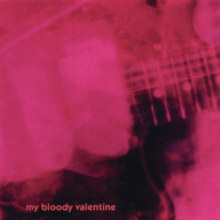
My Bloody Valentine: Loveless (1991)


(Creation/Sire)

!!! A+ RECORDING !!!

Before the release of the Glider EP in 1990, My Bloody Valentine seemed like an above-average noise pop band whose major claim to fame was inspiring, along with Cocteau Twins and the Jesus and Mary Chain, what British rock journos dubbed "shoegaze," encompassing bands like Lush, Slowdive, Catherine Wheel and Ride whose common approach to guitars was typified by distortion, heavy on effects. Most of the shoegaze bands sprang from England and revolved around a scene in London that tended to be derided by critics as detached and cultish. My Bloody Valentine, led by the supposedly mad scientist-like guitarist Kevin Shields, were a Dublin group, a distinction that meant a great deal, and were much older, which meant more. The band had its genesis in the late '70s, when Shields and drummer Colm Ó Cíosóig were teenagers. Their story progressed slowly, painstakingly, in keeping with what would become their reputation.

Shields is an interesting case, as rock musicians go. He lived around New York until he was ten, at which point his family returned to their home in Ireland and he became entrenched in the pop music world of the '70s as explicated by Melody Maker and Top of the Pops; in other words, despite an untimely departure from what was about to become the nucleus of one of the most fertile periods in popular music, he found his home. Nevertheless, he and Ó Cíosóig were seduced by punk along with everyone else and were aping their heroes as early as 1978 under the name The Complex. My Bloody Valentine itself began in 1983 when lead singer Dave Conway joined up. You can hear Conway on the band's first album (some say it's a "mini-album," but "album" and "EP" are exhausting enough distinctions), This Is Your Bloody Valentine, and several poorly received EPs including Geek and Sunny Sundae Smile. At this stage, thanks to Conway's swaggering melodrama, they were a shadow of the Cure, Joy Division and Nick Cave and all the goth-tinged seriousness thereby implied (although This Is Your... qualifies as a sort of protection against the later accusations that the band liberally lifted their sound from the Jesus and Mary Chain, since its recording in late 1984 predates the other band's explosion by nearly a year; similar charges in regard to the Birthday Party are harder to contest).

Once Conway was extracted from the lineup (he now writes sci-fi novels), the band recruited bassist Debbie Googe and, most crucially, Bilinda Butcher. Butcher plays guitar and keyboards on MBV's records but she also joins Shields in taking over for Conway on vocals. The impact on the band's sound and future by this development would qualify as immeasurable if one of the most fascinating back catalogs in alt-rock didn't make it perfectly easy to chart. Shields and Butcher don't trust themselves nearly as much as Conway; they fuss over their vocals, they almost whisper at times, and they tend to let their voices recede into the background of songs that increasingly tower with dreamy noise and buzz. Almost instantly, My Bloody Valentine gain a sound as a result of this evident shortcoming -- one distinctive enough to inspire a movement but also to never quite be duplicated in the nearly thirty years since.

My Bloody Valentine developed gradually, on a series of increasingly intriguing extended-plays, with each release presenting something that its predecessor had lacked. The feedback was always there, if muddied up by the cliches of post-punk and (on songs like "Don't Cramp My Style") thrash. Geek! added a layer of almost constant white noise. The New Record by My Bloody Valentine dispensed with a little of the gloomy machismo and acquired pop, melody, you name it, though you could still barely hear it; what do you want!? Sunny Sundae Smile is downright twee -- the title cut could be an Ian Broudie song -- though still heavy and traditional in a manner that would be discarded as soon as Conway departed.

The next two EPs, Ecstasy and Strawberry Wine later collected as the excellent full length Ecstasy and Wine, are the turning point. Dream pop becomes the framework, but with more sophistication than is typical of the genre, derived from psychedelia and underground heroes like Love and the Velvet Underground. The songs are swoony -- and the two singers coo and aah at length -- but they also breathe, they take time to explore grooves and rhythms, and they aspire to live in memory as songs as much as sounds. Shields finds a way by this point (1987) to make his feedback experimentation not just alienating but beautiful, and at best both as on "Clair." Strawberry Wine marks what sounds like the end of conventional folk-rock riffs in Shields' songwriting, but he at this point would have had a fully formed enough band conceptually and musically to be on his way.

But then came a legendary signing with Creation Records, and everything changed. My Bloody Valentine's breakthrough release was the EP You Made Me Realise, whose trebly and barely-stereo sound serve mostly to hide from the ingenuity and variance in its songwriting, and in the band's sudden confidence as a unit. More than goth rockers or mere twee romantics at this point, they are playing and singing music that discovers new, strange ways to be not just intellectually interesting but resonant and sexy. Everything tentative is suddenly gone. The proper LP Isn't Anything goes further -- the songs are weirder, less complete, almost disembodied; it's a complete anomaly and quite an invention unto itself. It was this album that gave way to MBV being labeled no longer a Mary Chain cover band but the originators of an entire scene. It also displayed Shields' savviness with concept; for instance, he left the noisier and punkier songs off and released them on a separate 12" (Feed Me with Your Kiss) so that the odd, surreal mood of the album was perfectly sustained. This indicator of the auteur's perfectionism, of course, carried foreboding indications for the band's future.

You can hear a lot of what the singers sing reasonably well on Isn't Anything. There are traces of discordance, like on "Lose My Breath," and the record inherits Realise's eroticism while also -- with a greater recording budget -- adding greatly to the band's warmth and dynamics. And the album's biggest innovation comes in the moments when the feedback, accompanied at times by keyboards, multitracked guitars and the vocals that Shields and Butcher were beginning to think of as just another instrument, doesn't just hiss or squeal but roars, discovering something musical and invigorating in the cacophony. Shields was dissatisfied. But in a sense, this would again have been enough.

A lot of money was expended on recording the follow-up to Isn't Anything; it famously bankrupted Creation Records and got Shields in all sorts of trouble with excessive studio time, the other members of the band feeling alienated, the press impatient, the label terrified. An EP, Glider, slipped out in 1990 with a proposed album song, an instrumental and two cuts that sounded like a logical progression from Isn't Anything. The album song, "Soon," was telling, though; it resembled none of the band's earlier work, save for the layered vocals by Butcher -- another absolute turnaround, but also an obvious progression. Brian Eno would memorably label it "the vaguest piece of music ever to have been a hit," quite a remark from that source. One thing for sure: it indicated that the band had already left the shoegazers behind. Another advance EP, Tremolo, followed. Then, after any number of studio changes, financial crises and panic attacks from Creation's top brass Alan McGee, at last came the evocatively titled Loveless in November 1991 -- more than two years after work on it began.

If you want an afternoon to go by very quickly, search for My Bloody Valentine on Youtube sometime. Not only can you watch them progress in various badly-shot but fascinating live shows starting as early as 1987, you can see the obviously shy and withdrawn Kevin Shields suffer through interviews, sometimes along side the even shyer Bilinda Butcher, from around the time Loveless was released. Shields, not even twenty-nine yet then, comes across as you'd expect: like a young cocky rock musician, the bane of whose existence is "assholes" in recording studios telling him what to do. He's forthcoming about how vital the creative freedom provided by the by-a-thread label is to MBV's continued existence, but rebuffs questions about the dilemma he put them in; and there's a cringe-inducing moment when one interviewer attempts to ask the two of them, who were then in a romantic relationship, about the "sexual balance" in the group.

It's a badly phrased line of thought -- not nearly as embarrassing as the idiot who, in a 2014 interview, informs the infinitely patient Debbie Googe that he had crushes on her as well as Butcher, "especially back in the '80s" -- but it gets at something that is one of the key sonic developments on Loveless. In bands with a male-female dynamic in the singing like the Go-Betweens, Belle & Sebastian or My Bloody Valentine, it alters the band's sound, makes it something different. Already on older MBV records, Butcher and Shields had often sung on the same track, sometimes in duets and at times with one backing up the other. On Loveless, their roles become more complicated. Buried as the vocal tracks are, they are unexpectedly intricate, with the two of them sometimes in perfect unison, one high (typically Shields) and one low; sometimes harmonizing but never conventionally; often tracked many times over; and very, very often singing in such a way that it's difficult to tell them apart. Their work here attains an androgyny that contributes to the album's horizon of weightless mystery but also its utility as a universal, sensory experience: obviously human but free of any forced meaning.

The other major evolution here is in Shields' guitar playing; by this time, as well as the band played together live, My Bloody Valentine in the studio essentially was Shields, a dynamic that's been treated with cheerful acceptance by Googe and eye-rolling frustration by Butcher. Since the early '80s, Shields had been toying with the bending of notes, with alternative tuning, with the tremolo arm -- an incredibly simple trick, but an aurally striking one that had never been incorporated into a rock band's music quite like it was on Loveless, including on the prior MBV releases that began to experiment with it. On this album, entire songs are built around the concept of this specific brand of disorientation.

It sounds like a lot of things that it isn't: corroded or malfunctioning tape, perhaps, or a flanger or some sort of elaborate distortion pedal. In fact, Shields wasn't using reverb, modulators, chorus or flanging at this point in his career and used only standard pedals, those sparingly. What you're hearing on Loveless is done primarily with just the guitars and amps. Nevertheless there are some tricks with tape and, of course, extensive overdubbing; he uses the studio, tries to use it more intimately than most engineers would let him, and does whatever is needed to get the sound in his head onto a record, including mostly mono sound. Brian Wilson circa Pet Sounds is a good frame of reference. Like Wilson, Shields' goal is hard to articulate but its emotional and sonic impact on the listener speaks for itself. You don't know, intuitively, if the sound of Loveless is accomplished by means that are simple or complicated. If you have no experience as a musician or around musicians, you have little reason to particularly care. But you know that the sound is different in a basic, primal way that can't really be described or pared down, and Shields could likely not have gotten us to that unfussy realization if he'd done this with a cloud of studio dust. The magic lasts across the literal decades too, since no one has appropriated the record's sound with complete success.

That is part of why Loveless is so unique, but not necessarily why it's great. In the cacophony, the grinding, the metallic bed of sound and the roar of it all, Shields discovers something so simple as catchy pop music that is resonant and addictive. The chosen medium of loudness matters, because it makes this a non-literal experience and puts us all floating and dizzy into a wonderful trance, especially played at top volume. It's druggy music insofar as it becomes the drug itself. Loveless starts exactly the same way as Isn't Anything, with an opening drumbeat marking time until throwing us off the cliff. This time we're diving into "Only Shallow," a scream of multitracked guitars that hiss and growl, a chaos broken eventually by Butcher's murmurs. We can guess at what she's saying if we want. We don't have to. It sounds like the hard parts of passion regardless, and the wildly expressive dynamic of soft melody and howling, transportive noise tells the whole story. "Loomer" is even prettier and more grotesque, Butcher humming over some barren landscape of all-but-tuneless feedback squall where time has stopped. The strange thing is not that it sounds completely wrong at first, but that it very quickly starts to seem where-have-you-been-all-my-life perfect.

"To Here Knows When" may be the defining track of Loveless. Again it prominently features Butcher's defiantly pretty vocals, now over a sonic soundstage of loop-pedaled feedback that is nothing short of enchanting as it seems to expand and contract organically, with more droning, so-very-wrong roaring guitar behind all of this. Loveless isn't prog; it has no such flighty ambitions for itself, its sounds are visceral rather than intellectual, and from what little we can make out of the lyrics (which, in a testament to the band's attention to detail, were nonetheless endlessly debated and revised), they are about the groggy thoughts we have just after waking up with someone and the troubles and joys entailed by that, following up an album filled with imagery of sex, violence and death. Maybe. Maybe not. Maybe the splendidly suggestive title implies an enforced distance between people. Maybe we are meant to hear just enough of the words to vaguely understand. It's poetry to match a complex musical idea achieved simply. "When You Sleep" can be described as nothing but pure pop despite its maximized volume; here Butcher and Shields sing together, multitracked about a dozen times and basking in a parade of hooks with guitars that would sound almost normal if the sheer number of them didn't create such a strange, alien effect. There are riffs and solos here, used the same way they are in any rock song, but the strange way they are played and recorded reshuffles the witness, makes us hear the way we respond to all pleasurable music in a distinctly new way, as though we're being rebuilt from scratch.

Both that song and "I Only Said" are built on looped riffs that barely sound like guitars, more like synthesiers or flutes (and indeed, MBV hired a flautist for live shows after Loveless; shades of Jethro Tull!?). To the band's arsenal of deceptively simple effects "I Only Said" adds repetition; the resulting hypnotic state matters less than the lingering, unresolved tension thereby created. The vocal melody, here centered upon Shields as far as we can tell, is equally impressive with its clipped verses that seem to finish a line halfway before starting what would feel like a different song if not for the consistent instrumentation; that means more than just that it's a shapeshifter. Loveless is the perfect nonverbal elaboration of tentative breakdowns in communication. It's like jazz, specifically free jazz -- dealing strictly with reactions to instruments, Shields and MBV find the emotional in the abstract.

The hypnosis effect reaches a peak in the album's midsection. After "I Only Said" lingers on its central trill for about six minutes, one of the album's darkest, slowest songs continues the spell. "Come in Alone" is almost a plod of sorts, hitting an implied romance with careful rhythm that would cast it as something very different from the rest of Loveless if the detailed production weren't so careful to incorporate the sound of the record at large in service to this track's specific beauty. Here more than ever the vocals are ambiguously gendered; you might think you know who's singing when, but you really don't. That astonishing, fevered sensuality -- a big part of what keeps one returning so often to this album -- carries forward to the famously gorgeous "Sometimes," a song that all but literalizes the feeling of being picked up and carried around by this music. Heard properly on good speakers or headphones, it's rapturously beautiful and absorbing. And while the powerful guitars, overdubbed on top of one another off into the impossible distance, are searing with love and pain, Shields' vocal is the elegiac vessel that glides through the changes and surrounds us. The less widely appreciated "Blown a Wish" is nearly as striking, another strange and clipped melody, here by Butcher, blown out into infinity by distortion but retaining its confessional, gut-level appeal as songcraft.

By 1991, over the better part of a decade, My Bloody Valentine had evolved from multiple incarnations and aspirations into a deservedly legendary guitar band, led (some say dominated) by a true visionary. Listening to their catalog now, it's astounding how linear the sense is that everything seems to have been slowly leading up to Loveless, a record that impresses and galvanizes to the extent that you can fool yourself into thinking it was a miracle that came from nowhere. But no, not only because Isn't Anything is a bright and complete artifact itself, but because Loveless simply synthesizes and pays off everything that Shields had learned. The last two songs on Loveless are as perfect, confident and restlessly creative as any rock band ever gets. The Shields-led "What You Want" seems divorced from any sense of time, a yearning pop song with a miraculously enveloping sound, the kind of recording so solidly brilliant that you could look at any element of it and be impressed. On one layer it's towering power pop, on another a stunning feedback exploration, on another something that manages surprising depth in its distant, wailed lyricism. He seems to be putting every bit of himself into it, and by the end of the song the exhaustion is palpable. Then a remaining loop rests for a time, one of many beautiful interludes that sound almost like accidents, and segues abruptly into "Soon."

More than any other Loveless track -- which is saying a lot -- "Soon" sounds new. It had already been released on Glider in 1989, but its positioning as the climax of this album still makes sense. Driven on a drum machine and the album's clearest riff, then another of Shields' oddball loops, the song sounds like a different band altogether. It sounds like something on the radio, really. Then suddenly, it explodes with guitar and without sparing us a second to process that, Butcher starts singing the group's strongest melody yet; the beat continues, so do the guitars, and it's almost as if the sun seems to come up after a long, bleary night. Several things remain surprising about "Soon" -- first that it does not sound like a relic of the shoegaze era. Second, that it's so easy to recognize but so indescribable. Third, that Butcher's vocal is so atypically confident, especially stacked against the rest of this album. All that makes this towering production sounds simultaneously like the beginning and end of something. Even though it was the first song released from Loveless, "Soon" seems to look toward the future with its suggestions of trip hop and club music fused with violently engaging guitar and its warping of what jamming out to the edge of the runout groove means in the context of rock music and disco. It's the kind of thing you hear and wonder what the hell we've been doing for the last twenty-five years.

But it also sounds oddly resigned, in a splendid and cathartic sense. Capturing the mood in the UK at the tail end of the Creation era, which Googe and probably the others would readily tell you was a very special time and place to be in a band, MBV seem aware on "Soon" that this is their moment and they are making the best of it. In a strange way, it already sounds nostalgic, like a million lost things inarticulately captured on wax. The flood of the years since seems to somehow be burned into it. It's a monumentally pretty and sad song, but it's also beat-driven and celebratory. Those contradictions, not least of them being pop pleasure burned out by overdriven sound and self-imposed enigma, are what made My Bloody Valentine and Loveless, which is the moment they were entitled to and their gift to us.

Loveless was released within two months of Nevermind, the album the music press chose as the heralded new faith of future rock music. It took many years, but Loveless is as widely celebrated as a classic now as Nirvana's album was almost immediately, and it's obvious now whose work had the more lasting effect on alternative rock if not the mainstream. My Bloody Valentine went on a widely remembered and mythologized tour in the year after the album's release. Shields might have been the extent of the band in the studio, but on stage they were a unit that played together brilliantly, whose modesty of appearance (Googe's wildly enthusiastic, manic movements excluded) belied the hugeness of the noise they generated. When you saw MBV live then (and if you see one of their reunion gigs now), the key moment is what's called "the holocaust," an interlude in "You Made Me Realise" that only goes on for a few seconds on the record but is expanded to ten or more minutes in live performances. Shields and Butcher stand still on opposite ends of the stage in front of their amps and, rapidly strumming the same chord for what seems like ages, generate a wall of feedback that's said to make people gradually lose their heads as it goes louder and louder. Eventually, at a certain decibel level, they go into a blissed-out trance state and maybe start laughing hysterically or just feeling high, so to speak, if they last long enough. Then, when the band is satisfied that their work is done, the song finishes. It's dangerous. Maybe irresponsible. (Signs always instruct audiences that earplugs are a requirement for an MBV gig.) But it says a lot about what the band was always looking to accomplish with sound -- yet again, as with their lyrics and bizarre use of conventional instrumentation, it's the quest for a feeling that can't really be pared down with words. But the idealized result is a kind of joy, a transcendent experience.

After Loveless, Creation was practically busted. (Sire released the album Stateside but it didn't do much here for a long time.) On the strength of the excitement generated in the press, especially the British press, about the album, My Bloody Valentine signed with Island and -- as an antidote to the head-butting from the 1989-91 period -- built their own home studio. But the well quickly ran dry. Recording on a follow-up started and stopped numerous times until everyone except Shields and Butcher gave up. Finally, in 1997, Butcher threw in the towel and the band essentially ended. Shields worked with Yo La Tengo, Primal Scream and Sofia Coppola. As time stretched on infinitely post-Loveless, increasingly sounding like the ethereal sendoff for a brilliant band whose star shone only briefly, he got a reputation as an eccentric perfectionist a la Terrence Malick. Interviews don't really bear this out. He admits to taking a long time to do things, but the air of arrogance surrounding a twentysomething who knows what he wants has faded. Shown these days with long gray hair (has that much time really passed already?) and a boyish enthusiasm for the elaborate effects pedals he once shunned, he seems more philosophical and lighthearted, which is what happens to people. Googe, who worked as a cab driver for a while then toured with Primal Scream and (currently) Thurston Moore, goes to gigs with him. Butcher has three children. The world moves on from thrashy kinds pogoing around in the front row of London shows in the '80s that still survive on fanmade video in curious perpetuity.

My Bloody Valentine reconvened in 2008 and eventually -- quickly, by Shields' standards -- released an album five years later. Mostly recorded in the '90s, it sounds like what it is: a solid follow-up from a band that wasn't quite sure where to go next. By Shields' own admission, it doesn't have the Loveless quality of "looking into another world." Recorded mostly in the mid-'90s during the Island period, when the band members were all in the same place waiting for something to happen, it doesn't radicalize My Bloody Valentine's position -- with the expectations attached, that would have been very difficult -- and doesn't necessarily "evolve," a concession made even by its champions. Its biggest contribution to the band's legacy, besides a well-deserved victory lap and some good songs, is that it places less emphasis on song structure and melody but is also less attuned to an ideal of mystery. As an entity, My Bloody Valentine was never really as mysterious as critics made them out to be anyway, but their music was.

It may be that Loveless is a hard act to follow, made harder by the long silence afterward, because it essentially says and does everything MBV could have done. It's a nearly immaculate creation, timeless and ghostly, and it demands to be heard in sequence and without distraction like few other albums. A consistent drone and roar accompany the entire album, its mood established beautifully and confrontationally then elaborated upon on a series of romantically charged pop songs that nevertheless put one face to face with the unknown in their endlessly weird, sensual sound. Not only does it do something genuinely different with rock music, it expands the idea of the album for the CD era (though I have no doubt it would be something to hear on analogue vinyl, I've never had the pleasure) -- on top of crafting an ambiance that's never disrupted (even by the relative throwaway "Touched," which serves mostly as a tape-looped intro to "To Here Knows When" and prelude to "I Only Said"), like Pet Sounds it offers songs that comment on one another musically if not conceptually and, unlike Pet Sounds, provies an impetus for both massively loud shared catharsis and intensely private indulgence in sound and song.

We're moving into the subjective here but I think it's the greatest, most beautiful rock album recorded in my lifetime -- borne out by the sensation that it never seems to age, like the band and I have, and still sounds newly revealing and richer yet each time it surrounds me yet again. I'm not alone in this assertion. Follow-up or no follow-up, we're lucky the unique moment in which Loveless could be made existed. Because as a piece of music, its moment won't ever pass. I think that's enough.

Friday, November 28, 2014

Dreaming like a fool: September 2014 albums

The rare month in which something old I discovered -- the Art Blakey album -- eclipsed everything new or kind of new that came to my attention.

***

Y.G.
My Krazy Life (2014)

(Def Jam)

RECOMMENDED * The chief takeaway here is how incredibly influential Kendrick Lamar's good kid, m.A.A.d city already is, just two years after its release -- this is a considerably lighter take on the same basic idea, of a reformed young petty criminal autobiography framed as a cautionary tale and apology, replete with Mom as a framing device. But Y.G., while quite talented, is way way waaay more impressed with himself than Lamar is, and the record lingers a lot more on the fun, just-wanna-party aspects of the "before" picture rather than the one-song-and-change of the redemption. It's a whole record of "Backseat Freestyle"s. And you know, that's really fine, especially if you're nostalgic for a time when hip hop could be this full of guilt-free boy problems and bravado; parts go farther back than even gkmc, with old-fashioned scratching and vocoders and what-have-you. The sad-gangsta finale "Sorry Momma" borrows from the Nas playbook quite well, and there are some good bangers ("Left Right" is the best) and a kinda funky home invasion narration ("Meet the Flockers") to counteract Lamar's harrowing one. But it's telling that the record's most impressive moment by a longshot is Kendrick L.'s own jaw-dropping verse on "Really Be." Skip that song if you intend to actually listen to My Krazy Life and not just pause it and go pull out gkmc.

Art Blakey & the Jazz Messengers
Moanin' (1958)

(Blue Note)

HIGHLY RECOMMENDED * Archetypal hard bop reaches six titanic heights under the intelligent leadership of Blakey, who in addition to his steady pulse will change an outsider's mind about how much there can be to a drum solo. The breathtaking moment to write about among many is probably Lee Morgan's trumpet solo in the title cut, which is over just a couple of minutes after you lay down the needle on side one, but everything else is priceless. Personal favorite full selection is "Are You Real": what a song, what a performance, like a romantic chase scene. Blakey's great talent was in letting good but underused soloists explore their voices. Morgan, saxophonist Benny Golson, pianist Bobby Timmons -- their names might mean little to you, but their sounds won't once you've heard this.

Future Islands
Singles (2014)

(4AD)

RECOMMENDED * Without going into specifics, I know firsthand that this is a band that has really, really paid their dues and I'm quite excited for them that they've started to reach their current level of success and attention. They're basically a synth-drenched revision of grandiose pop in the vein of the Alarm, U2 and OMD, and they write some lovely songs ("Spirit"; "A Dream of You and Me") but there's a but. (For many, it won't be a but.) Singer Samuel Herring has a, well, very unique vocal style, like if Peter Gabriel, Peter Murphy and Peter Garrett were all the same Peter. Pairing that eccentric, lower-register croak with this sort of expansive music is a textbook example of "not for all tastes," but it'll inspire endless passion in certain quarters. I dig it, personally, but I can only take so much at a time before I have to listen to somebody who will calm the hell down. Herring sends songs in directions that seem to have nothing to do with what his band is doing -- "A Song for Our Grandfathers" defines this dichotomy. Maybe it works. Maybe they will eclipse Sandra Bullock as the most famous ECU alumni.

Fatboy Slim
Better Living Through Chemistry (1996)

(astralwerks)

!!!!! AVOID !!!!! * My late-'90s instinct to stay away from this gimmicky, crude charlatan was correct -- this is a guy who thinks you need drugs to truly enjoy music, and with his own work this repetitive and pandering it's no wonder he'd consider that a prerequisite. All of these songs sound like the generic instrumentals and bad jokes they play behind morning DJ patter. Worse than Jock Jams; if you don't believe me, try all six minutes of "First Down."

Protomartyr
Under Color of Official Right (2014)

(Hardly Art)

Generic indie rockin' that sounds like a post-punk band trying it all again straight outta 2004. Nice work if you can get it; sorry you missed 120 Minutes. "It was somethin' that I read in a book," yeah, What Color Is Your Parachute? amirite?

EMA
The Future's Void (2014)

(Matador)

RECOMMENDED * Erika Anderson's third album and follow-up to blogosphere smash Past Life Martyred Saints is even more raw and complex, if ultimately a bit generic in its "the '90s live again!" conceit -- "So Blonde" really, really sounds like something from Live Through This or Bricks Are Heavy, and that's just one among many. It's also more substantive than a lot of other singer-songwriter records, including Martyred, and a lot of Clinton administration throwbacks like Speedy Ortiz and Yuck. Anderson reads Lovecraft apparently, and on a semi-related note builds a hook on "my Lucifer, my Lucifer" which some will find a welcome antidote to another current act with similar taste's "my nightingale, my nightingale." When I listen to "When She Comes" I feel like I'm hearing a great cover of a Velvet Underground song I somehow didn't know. When I listen to "100 Years" I feel like taking a nap. Anderson holds back a lot under cover of coy abstraction, like St. Vincent and Spoon, which makes her easy to digest, a little hard to enjoy, and very much an artiste.

The Avalanches
At Last Alone EP (2001)

(Toy's Factory)

RECOMMENDED * Fourteen years and counting since their now-legendary album was released, this odd stopgap has now gained more attention than it's meant to carry. Five remixes of songs that don't really make proper sense outside their original context. One masterpiece of a flawless, unbelievably euphoric dance song in the form of "Everyday" -- if you love Since I Left You and haven't heard it, get thee to Youtube or whatever. All else in its shadow: the three other songs reprise it and/or undercut it and/or noodle, though "Undersea Community" is a mildly amusing fragment. But if it's the only way you can get to "Everyday"...

Woods
With Light and With Love (2014)

(Woodsist)

RECOMMENDED * "You call it sleep but it feels like dead." Well, I dunno. First of all, one of those is a noun and one isn't. Second, I hear the Byrds more than the Dead, though I guess some of the guitar solos do wander off. Have you heard Woods before? Then you know what you're getting -- respectable, nostalgic folk rock with one kinda ludicrous, kinda fun interpolation of "My Sweet Lord." Tune in, turn on, etc.

The Walkmen
A Hundred Miles Off (2006)

(Record Collection)

HIGHLY RECOMMENDED * It's never made sense to me personally that this wasn't a widely loved record. The Walkmen were the only new rock band I really listened to much in the mid-2000s, a time when I was thoroughly concerned with movies, '50s rock & roll and Yo La Tengo. I greeted this album with enthusiasm and wasn't even aware until years later that it was seen as a disappointment. Admittedly, it's a transition -- it can now be heard as the tipping point between the Walkmen's more aggressive early work that produced their immortal Bows + Arrows and the later, possibly even more effective gentle riffage upon Van Morrison, Sun Records and doo wop. The band is always a solid foundation, with Hamilton Leithauser loud but seldom asserting himself as the center of attention, and in a way maybe this is the ideal introduction to them -- old-fashioned, straight ahead rock & roll with sensitivity, propulsion and charm. Two admissions: though no cut is noticeably weak, there are really only three songs that rise above everything and assert themselves, and all three look ahead to You and Me and Lisbon: the horn-drenched road song "Louisiana," the bitter but strangely romantic road song "Lost in Boston" and the elegiac "Another One Goes By," one of their very best. Second caveat is that I do indeed listen to this less often than the other five, but checking in again I am not entirely sure why. I continue to miss the Walkmen -- they went on "hiatus" just after I realized they were probably the most consistent young-ish band of the last decade.

Rodney Crowell
Tarpaper Sky (2014)

(New West)

Stripped down to nothing compared to most mainstream country, which is why it gets positive attention, but Crowell retains a generic Texas twang that covers up the virtues of his writing. He does sound a lot younger and newer than he is.

Sam Cooke
Cooke's Tour (1960)

(RCA Victor)

Cooke's dual personalities are interesting: the old-fashioned crooner recording "theme" albums for RCA and coming on like Dean Martin or Nat King Cole versus the sweated-out R&B singer whose hit ballads carried an undercurrent of sensuality even when they were going on and on about Cupid. His voice was, of course, undeniable -- but this phony travelogue (a lot of coffee in Brazil, all that shit) is tedious beyond comprehension. This is Disc One in a box of this true luminary's RCA albums. I hope I'm wrong and that my curiosity about his more obscure work is justified, but this doesn't bode well for his consistency as a sustainer of thirty-minute pop records. Which is really not a surprise or even a particularly fair critique, except that of course you wanted it to be different.

The Both (2014)
(SuperEgo)

Album of drinking songs from a sort of cross-generational collaboration: Aimee Mann and Ted Leo. (There's only ten years' age difference between them but 'Til Tuesday and the Pharmacists are at least two decades apart in their cultural moments.) Run the Jewels it's not, but Mann's blandness seems to be offset by the sprightlier efforts of Leo, though there's really no trick to having more presence than Michael Penn. One's response to this is very strongly dependent on one's fondness for what A&R types call "adult alternative." Not my thing, but good luck to all.

Art Brut
Bang Bang Rock & Roll (2005)

(Fierce Panda)

RECOMMENDED * Funny, smarmy, whatever. Blunt. Just like their name! Power riffs! Garage rock that doesn't serve any redeeming social purpose -- the punk of pettiness. "Look at us, we formed a band." "Every girl that I've seen since looks just like you when I squint." It's all so smug and dumb it's almost funnier when it tries to get subtle. Credit "18,000 Lira" for defining a sound in less than two minutes like we did in the old days, "Fight" for making fun of alpha males.

eels
The Cautionary Tales of Mark Oliver Everett (2014)

(Vagrant)

!! CAUTION !! * It sounds like E, who hasn't had an easy time of it, is working on his demons while wailing out his latest tunes as he wanders off into that good night. So what else is new. Only problem is, unless you're some kind of an auteurist, there's just no really compelling reason to listen to him doing so.

Earl Bostic Blows a Fuse (1946-58)
(Charly)

RECOMMENDED * According to Art Blakey, who knew his shit, alto sax player Earl Bostic was a primary influence upon Coltrane, something that you can't necessarily detect from this well-mastered hodgepodge of R&B-tinged jazz and novelty pop. But it is tremendously fun to listen to anyway; his version of the standards "Night Train" and "Harlem Nocturne" are among the best and punchiest I've heard, and no one can grow up in the Carolinas without some affection for "Flamingo," as much a signature beach music touchstone as Maurice Williams' "Stay," My personal favorite Bostic single is the wickedly funny "Who Snuck the Wine in the Gravy?", a probing mystery with a twist ending. Bostic's playing is joyous and inspired throughout the collection, which is available digitally from Amazon -- but the material is uneven. I have a feeling there's a more convincing introduction out there somewhere. If you're a jazz freak and don't know Bostic, try the great, ahead-of-its-time (1948) party record "That's the Groovy Thing" on for size, followed up with the terrific, manic soloing on "Don't You Do It."

Kelis
Food (2014)

(Ninja Tune)

RECOMMENDED * Half of a terrific album -- stylish beyond your expectations, and delightful to anybody reared on raspy-voiced Mary Wells, Stax/Volt, A Tribe Called Quest and Sesame Street. Main caveat is that while Kelis has excellent taste and cultivates ideas well from disparate sources, she doesn't have much skill at curating them, so as is sometimes the case with Erykah Badu's earlier albums and most of Beck's, it's genius with no filter. This manifests partially in the record just being a bit too long, but more specifically on misjudgments like the godawful Blueshammer-like "Friday Fish Fry." Almost everything on the first two thirds is good to great; being too easily seduced by concept doesn't change the fact an album with weird food metaphors sure beats one that strings together creaky standards that happen to have names of cities in their titles (see Mr. Cooke above); and opener "Breakfast" is the best Jackson 5 rip since Bibio's "K Is for Kelson." Despite the problems, don't miss.

***

The October post is a short one, which should be ready around the sixth of next month, and then a huge rush of new releases, mostly capsules with a few longer pieces interspersed. Right now we seem on track to have a Best of 2014 post before the calendar year actually ends, but don't hold me to that please! Try to pretend it's true despite the overload. (Ahem. Two big A+ titans getting their due here first anyway.)

Wednesday, November 26, 2014

tUnE-yArDs: Nikki Nack (2014)


(4AD)

HIGHLY RECOMMENDED

Because Merrill Garbus' previous tUnE-yArDs album, w h o k i l l, has played a large role in shaping the musical landscape of these last few years for me, it is difficult to look at her, or her band, or her follow-up record, with any kind of objectivity. My personal feeling of loyalty and attachment to everything about her work is on a level that has, as I've gotten older, become something of a rarity for me. Perhaps these ties became stronger when we saw Garbus live days after the death of my father and I felt, honestly, more alive in that crowd than I ever had in my life. Perhaps my immense respect, verging on fawning, betrayed me when I interviewed her in 2012 and did my best to write a coherent article about it -- in the end, the piece was so heavily edited as to become unrecognizable, and I haven't been paid for a piece of writing since. Maybe, in other words, I'm a g.d. fanboy. All the same, I have to swallow all such questions and stand by every claim I've made that Garbus is a major artist, among the most major currently visible, and I breathed a sigh of relief when I went back and read what I wrote here just a week after discovering her and had already detected that the key to her immediacy and charm was that her bottomless exuberance was undercut by a healthy, probing maturity.

To put all this another way: a lot has happened since what might be the finest record of the last ten years was released. The Village Voice's annual Pazz & Jop poll unexpectedly lent victory to w h o k i l l instead of Bon Iver's Bon Iver (which I heard half a dozen times, and about which I remember nothing). Chuck Klosterman plastered his ignorance about everything that lay outside of Chuck Klosterman's own cushioned skull in the blather he wrote about her "asexuality" in response to the P&J victory, which is often cited as a fluke in a year without a clear favorite a la Arrested Development. Garbus has performed with Yoko Ono and the Roots, has opened for Arcade Fire in stadiums and quarries, burned herself out on her songs and her old touring arrangement that featured her plus bassist Nate Brenner plus a pair of saxophonists, has toured and experimented and gotten weirder and friendlier, and has released her third album. We've had the better part of a year now to explore it, and much like w h o k i l l, it reveals the danger of saying too much too soon. That album continues to reveal previously unheard nuances (lately, for me, in "Bizness" and "You Yes You") after three years. This one now sounds vastly different to me than it did on the week of its release.

When you come to the sequel to a record that you adored unequivocally and that changed your perception of modern pop, it's part of the game to temper yourself: you know this can't possibly strike you in quite the same violent, earth-shattering way the last one did, and in this case I knew that because almost no other record released in this century does that. Truthfully, these twelve songs (plus spoken interlude) don't strike and bite and purr nearly as directly as their 2011 predecessors. Disregarding its prowess as a piece of pop production, engineering and technical mastery (we'll come to that), it's far more like BiRd-BrAiNs than w h o k i l l. The songs saunter and strike and wander much as they did on Garbus' earlier recordings, only now with a more unwavering sense of purpose; they don't really go for the jugular like "Riotriot," "Gangsta" and "Powa." It's strange to call a record as bombastic as Nikki Nack subtle, but in writing and impact if not sound, it surely takes more time asserting itself than we might have expected. As it turns out, this is deliberate -- and really, we never doubted that, but some trace of initial disappointment was inevitable anyway.

What changed? What made this not one of the best records of the year just by default but a formidable evolution of a truly gigantic artist and band? Part of it was the obvious and instant desire to get to know it better; informed as this impulse is by Garbus' previous work, it's valid -- she demands to be heard again and again. And the songs that stood out stood out profoundly, and I wanted to know why. The advance single "Water Fountain," good as it is, was unavoidably and surely intentionally similar to the general sound of that record with just a hint of new direction -- it is very much like "Gangsta" and "Bizness" placed into the same song. It's even political in precisely the same way that the previous album was political. So for me, "Wait for a Minute" and "Manchild" were on first listen and now on sixteenth or seventeeth remain the highlights of Nikki Nack. And it was readily apparent that they were distinctive and grand for reasons that did not seem to comply specifically with what I heard in w h o k i l l.

Gradually when exploring these two songs, which truly knocked me out emotionally, and the bits and pieces that sort of reminded me of them elsewhere on the LP, it became clear what Garbus had done and why I was looking at it the wrong way. Garbus and Nate Brenner aren't reaching for the same goals anymore, and they've essentially moved the stage and started over. Some contextual factors help to see all this. Spending a lot of time with the album, the way we all used to when we were kids, helped. Hearing it on vinyl was a revelation -- the immaculate mastering of the LP preserves vast reservoirs of aural information in the lower registers it doesn't even occur to you to look for digitally; parts of "Stop That Man" and "Left Behind" sound like they are poised to physically lift you. And seeing the new songs performed live, where they unfurl in the new extended lineup (Garbus, Brenner, extra percussionist, two backing singers and dancers), would have rendered the album dangerously irrelevant if it didn't cause me to suddenly realize I knew every word, chorus, bridge, vocal tic or stick click by heart without even knowing I'd memorized them -- and indeed, if it didn't take a veil off the emotional depth of these songs.

w h o k i l l was an assaultive record. That's what made it so vital. It was a firebrand that came from a woman on unfamiliar ground, anxious to learn about herself and the world around her -- it was outraged, passionate, powerful. Nothing about it seemed careful or immaculately constructed. Nikki Nack, on the other hand, is a precariously shaped tower of ideas. The songs often wander into unexpected (and usually delightful) tangents. The ukulele has all but disappeared. The drums are no longer paramount; it's never about whatever's handy anymore, it's about what works in the moment. There is endless variance of style, theme and mood across the album, all of it worked out with audible precision; such variance also exists within the songs themselves, as witness an example like "Left Behind" that is wholly unburdened by even a few minutes' work of expectation.

After two albums of self-production, the first of them famously put together on an easily downloadable piece of freeware almost everyone with a PC has used at some point, tUnE-yArDs (now pretty much officially a duo, Garbus and Brenner) for the first time looked to an outsider to change things up. That is the Grammy-winning producer Malay, known for work with Fantasia, Big Boi, Alicia Keys, John Legend, and most famously the bulk of Frank Ocean's P&J winner Channel Orange. The new colors this brings to tUnE-yArDs' routine are quickly evident. There are cons -- professionalism in the studio mutes Garbus' personality just a tad, and has the effect of making her seem like just one more sound in a spectrum. The slickness that befits a fine performer like Fantasia or that gives Ocean's record such special resonance in its best moments isn't necessarily ideal for the person who gave us "Hatari" and "Es-So." For the most part, thankfully, Malay tempers nothing about Garbus' personality -- and he finds an unexpectedly maximized life in the underbelly of her songs that gives them new life of a very different sort.

The bass-heavy sonics are a shift, to say the least -- more so than you realize before you hear the album on a good system and compare it to older t-Y albums. This is most apparent on the massive "Left Behind," which in and of itself is middle-tier tUnE-yArDs but comes more alive the louder you let it, because so much of its wildly enveloping unease and drama is dependent on volume, which is hardly a criticism -- a huge recommendation with instructions, more like. The trend is equally pronounced if less assertive elsewhere. It might not have the bite of "My Country," but those synths on "Time of Dark" and the "see me over the mountain" primal-scream chant come off like the apocalypse once you listen properly. Despite the Burt Bacharach interpolation ("Always Something There to Remind Me" -- hey, she quoted Elvis on "Fiya"), the slow burning "Look Around" has all sorts of life buried in its mix that require your close examination. Despite the New Order interpolation (the opening drums on "Blue Monday"), "Sink-O" has rhythms too nutty, basslines too melodic and compulsive, to call one's mind to anything except Garbus set unexpectedly free in her new surroundings.

When I wrote about w h o k i l l, one point I was very insistent on was that it was "body music." I was right, but it now seems like a silly thing to have belabored then; in retrospect I was hearing an aspect of tUnE-yArDs that had only just begun to develop. More clearly now, w h o k i l l was a punk rock record -- turned upon the world to sing out and demand. Nikki Nack is R&B, often very straightforwardly. Despite being outrageously menacing and "big," "Stop That Man" and "Left Behind" both subsist wholly on rhythms and vocals driven directly from American soul music of various periods, particularly the '70s and late '90s. Playful as it is, "Manchild" is unambiguously groove-driven dance music, and there are no caveats to speak of in "Wait for a Minute" -- it is an R&B ballad, in writing, arrangement, and synth-heavy production.

A further peculiarity to Nikki Nack that seems obvious in retrospect, so seamless does it evolve from a sound Garbus already established, is its use of schoolyard-chant elements to bring forward often complex, usually incendiary ideas. From BiRd-BrAiNs onward, a sense of innocence in Garbus' lyrical dissections of class disturbance and social alienation was well matched by both her periodic attachment to simple, shouted phrases (see "What's that about? What's that about?" on "You Yes You") and her frequent use of recordings of children speaking, yelling or even eating. Like few recordings outside of hip hop, "Water Fountain," a sharp three-minute pop song about contaminated city water that varies and elevates itself freely without ever losing focus, sounds like a busy city street in the middle of the day: kids playing, adults dicking around and going places, families scattering and reforming, good and bad shit going down, and the occasional loud car or burst of music. But the chorus at the center of it suggests nothing -- nothing western, nothing African, nothing rock & roll -- so much as children shouting their taunting, time-tested rhymes while jumping rope.

The use of chant, of quick and sharp phrasing as a means of communication, recalls Bob Marley's best-known songs for their deceptive simplicity putting across large and sometimes uncomfortable truths; the heaviest, most difficult lyrics on Nikki Nack tend to be paired up with the starkest, most clipped melodies and choruses. The relentless call-and-response "Real Thing" is a challenge to appropriation accusations and yet its target seems largely to be Garbus herself, though "I come from the land of slaves / let's go Redskins, let's go Braves" is pointed in another direction, and so cutting and well-placed it incited a spontaneous cheer at the show I saw. "Hey Life" describes (with a Coasters reference!) exhaustion, mortal burnout and a panic attack with a weird joy that renders it confoundingly tense: "One, two, three o'clock, four o'clock / Walk and walk and talk and talk and walk and talk," spewed out in rapid monotone, in so few words eloquently convey the feeling of not being in control of one's own life. It says all this musically too, and masterfully so, tinkering then tapping then exploding. Similiar anxiety permeates the darkly worldly "Sink-O": in the bridge, Garbus eats Pop Tarts and watches The Voice; she "cannot fall asleep but cannot face the day."

And it's more than the day -- kind of a satire of empty liberalism, "Sink-O" prompts a quick-witted investigation of oblivious folk literally swallowed up by a world of limply protested racial profiling and drone strikes, but lays little blame at their feet, since Garbus charges herself with being just as guilty of looking the other way as the rest of us. This is a recurring point in her interviews, that part of her art is that she has no superiority, no answers. They seem as frustratingly out of reach to her as to us. That was true on w h o k i l l as well, which hinged on the tortured "when they have nothing, why do you have something?" question, but that was an album that participated in fist-in-air celebration and fighting back, or at least self-consciously pushing back against one's inability to do so. Nikki Nack prevents any true release like that of the "freedom in violence" climax on "Riotriot," the joyously apathetic capitalism of "You Yes You," and the unabashedly beautiful classic-soul bridge on "Doorstep." On Nikki Nack, the kids just keep skipping over the rope, which keeps turning and turning.

That sounds fatalistic, I suppose, and maybe it is -- but it's also poetic. Because tUnE-yArDs have become increasingly sophisticated as a band even as the music seems to become compositionally ever more primal and stripped back, they are able to waver uncomfortably on these ideas for long stretches and make large points without preaching or "bringing them home," so to speak. In some places they call that jamming. The band intends to make us uncomfortable, and it's commendable. We can't confirm if Garbus is vegetarian (or vegan), but the Swiftian spoken interlude "Why Do We Dine on the Tots?" -- performed in the style of Nicki Minaj's opening readthrough of an excerpt from Roald Dahl's Revolting Rhymes in the Kanye West song "Dark Fantasy" -- is certainly designed to make us question ourselves if we're not, and on that evidence and the lyrical sway of the album toward self-criticism, either conclusion is equally likely.

BiRd-BrAiNs fans are bound to be somewhat relieved after all this by the simple, spiritual-like "Rocking Chair," which sees Garbus exercising her more familiar vocal tricks again. w h o k i l l fans will be relieved by "Manchild," which gives us at last a chance to participate in a real shouted-along triumph: a righteous, brilliant anti-rape, anti-slut-shaming, anti-MRA anthem. Garbus has performed with Yoko Ono a few times in recent years, including helping out on her 2013 album Take Me to the Land of Hell, and the barbed, witty "Manchild" ably takes up the mantle of Ono's best music -- it's elegant and specific in its rhythmically expressed anger. "Oh little manchild, look at your pants / an accident happens each time we dance," great, "I mean it / don't beat up on my body," greater, but the singalong hook of the year? Here: "Not gonna say yes when what I really mean is no / Not gonna say no unless you know I mean it." It's the anti-"Blurred Lines," and a wondrously moving rebuke to the wrong side of a culture, the only time on Nikki Nack wherein the premise seems to be that there is such a thing.

Garbus' vocals, the center of everything on her first two albums, are sometimes backgrounded on this LP, but once you overcome that obstacle it's easy to hear that her voice has gotten steadily better and still more adaptable. "Look Around" might be the best exposure here; it begins with a coo then slowly bristles and seethes. "Real Thing" grabs a little of the Mahotella Queens / Andrews Sisters stuff from "News" but her control is obviously greater now. She her live for proof -- how her movements vary according to whether what she's singing is in a spirit of sarcasm or sincerity; when it's the former, she moves with the clipped robotics of David Byrne in Stop Making Sense. And when she's doing a highly personal song like "Find a New Way," the opening cut that almost directly narrates the composition and creation of the album itself (a notion that owes at least a little to Leonard Cohen), she is looser, freer. These are both skills of a different sort and she knows when and how to employ them, with greater exactitude than ever before.

The voice is still what drives the hooks, though. One element of this record that's difficult to get used to is how frequently the various parts of these songs seem almost disconnected from one another. It takes a long time to intuitively understand that each verse, chorus and bridge of "Sink-O" and "Real Thing" (which also wanders into the album's craziest musical interlude) all belong under the same title. It says a lot, still, that these fragments make their way so snugly into one's head so quickly. And if side two of Abbey Road has taught us anything, it's that we shouldn't fault pleasing little moments for not leading us anywhere in particular. Quick -- which song has the "peace / peace and love / love is waiting" bit? What about "holiday! holiday! let's go crazy!"? Maybe you know, maybe you don't, but I bet you remembered both melody lines instantly.

Out of all the advancements on Nikki Nack, and there are plenty even if it doesn't rise to the heights of its predecessor, Garbus' lyrics stand out as the prime achievement. Already capable and compelling, here she proves herself one of those rare artists whose words truly reward as much of our attention as the music. Her first record consisted mostly of personal songs about the sort of aches we all know well. Her second, like so many second albums for generations before her, expanded outward to try and understand the larger world; she did it better than most. She still does: that blood-soaked dollar on "Water Fountain" is something else. But Nikki Nack fuses self-narrative with politics in an often striking, incisive manner. On "Manchild," "Hey Life" and "Real Thing" the line thins -- it was impressive that Garbus seldom seemed to be speaking from her own voice on w h o k i l l. It's impossible to know for sure if she is now, but that she seems to be and is so sincere and witty in doing so (like Tracey Thorn or Josephine Olausson, and trust me when I say I do hate comparing her in this sense strictly to other female singer-songwriters, but the pickings are slim for men who write about themselves and don't sound like total assholes -- see: masculine self-pity charlatan Mark Kozelek) is disarming enough. She's funnier and sadder now, when her points are obvious and when they aren't. She even talks about finding this new voice and describes it to us while we're hearing it, like Win Butler telling us what we're feeling on The Suburbs only more exciting.

Way back in 2009, Garbus wrote and sang this in what was probably her first truly perfect song:

I am not beautiful
I am in bloom as the world goes underground
And I am not beautiful
And I am not magic yet
But I am in bloom at the end of the world


That was "Fiya," the one about how she should have just stayed at home, the one about her own skin making her skin crawl. And in the wake of five years of ever-increasing success, of playing and being adored by the people who come to her shows and buy her records, of being taken seriously as an artist and having occasion to be challenged and to collaborate, and to form what seems to be a creatively fulfilling relationship with her partner and bandmate, what does she now have to say about what goes on in her inner world?

Monday, I wake up with disgust in my head
Could not forgive myself another moment spent in the bed
Monday, the mirror always disappoints
I pinch my skin until I see the joints

Today I'm feeling like I live on the ledge
Any moment I just know I'm gonna fall off the edge
They say, "hang on"
I promised them I will but I don't know for how long

Why do I spend the soul of my day
Looking for any way to waste away?
The pain is in the empty time
Just twiddling my thumbs and hoping for the words to rise

Today I couldn't stand to be all alone
And sick of hearing my voice on the telephone
A thousand roads to injury
Most of them so smooth it doesn't feel like they're hurting me

Not knowing what the future will bring
Is always wrecking my day
I guess I'll drown my fear and seal my fate
A haze of cravings
Easier to do it than just sit here and wait


That is "Wait for a Minute," apparently another song about Merrill Garbus loafing around between albums feeling disillusioned with her entire process, herself, her work. None of us know what it is like to be Garbus. Lord, if I did, maybe I'd be capable of writing a once-in-a-lifetime line like "A thousand rodes to injury / most of them so smooth it doesn't feel like they're hurting me." But this song, the sincerity and selflessness of which produces a lump in the throat without exception, gets across beautifully and utterly free of pretension how much her struggles mirror our own. It's because of the lovingly unassuming way she sings it just as much the way it's written. And in a career that has been largely about the act of questioning privilege, especially one's own, it is major that the most open-hearted and unguarded song she has written since her earliest days on this project appeals to a common humanity. I need to stress here that in the sphere of influence she has among the people who care about these things, Garbus is a Big Deal. She means a lot to people, me among them, who are ordinary and live ordinary lives and do their best with sometimes lonely, throttling struggles. It is not a small thing to know that someone who is a hero to a lot of us not only deals with the mirror, the thumb-twiddling, the binging on Pop Tarts and the being sick of oneself, but is willing to go out into this huge world and talk about it. That is a major, colossal, unspeakably touching thing. Maybe this kinship I'm suggesting is the mark of a bias but I doubt it. As the song goes, "Even in silence there are voices who will sing."

***

You can now read my complete (though short) 2012-vintage interview with Merrill Garbus here, dug up from the gmail archives for the first time eva! More tUnE-yArDs reading from me (if you want): Essays about BiRd-BrAinS and w h o k i l l, writeups of the shows I saw in 2011 and 2014, and the (very abbreviated and clumsy) profile for Metro Times Detroit.